Back-to-School Routines: Executive Function for ND Teens
The January Reset No One Talks About
Fall gets all the back-to-school energy. The supplies, the schedules, the fresh-start optimism. Pinterest boards full of color-coded binders and morning routine charts.
January? Crickets.
But here's the thing: spring semester is its own transition. And for a lot of families—especially those with neurodivergent teens—it hits harder than fall.
Winter break is short, unstructured, and chaotic. Two weeks of no alarm clocks, irregular meals, and screen time that quietly spiraled. Whatever routines you built in the fall? They didn't survive the holidays.
Your teen isn't broken. They just forgot how to do school for two weeks. And now they're supposed to snap back like nothing happened.
You're not imagining that this is hard. It is.
Why Spring Semester Hits Different
Fall has built-in momentum. New teachers, new classes, maybe a new school. There's fresh-start energy baked into September.
January has... Monday. And whatever habits managed to survive the holidays.
For neurodivergent teens especially, the challenge isn't the routine itself. It's the switching back. Transitions between tasks, settings, and expectations are consistently reported as one of the top challenges for students with ADHD, autism, and other executive function differences.
And here's what makes it tricky: neurotypical kids often absorb routines by watching others. They pick up on cues, adjust without being told, and slide back into school mode within a day or two.
Neurodivergent teens usually don't. They need explicit re-teaching—not because they're less capable, but because their brains process structure differently. The routine didn't stick automatically, so it needs to be rebuilt intentionally.
That's not a flaw. It's just how it works.
What Executive Function Actually Means (Plain English)
You've probably heard the term "executive function" thrown around. Here's what it actually covers—no jargon, no acronyms.
Working memory — the ability to hold information in mind while using it. This is what lets your teen follow multi-step directions without losing track halfway through. When it's weak, they hear "go upstairs, brush your teeth, grab your backpack, and meet me at the car" and arrive downstairs confused about what they were supposed to do.
Cognitive flexibility — the ability to adapt when plans change. This is what keeps a small schedule shift from becoming a full meltdown. When it's weak, unexpected changes feel catastrophic, even if they're minor.
Inhibitory control — the ability to pause before acting. This is what stops impulsive decisions—blurting in class, texting back immediately, buying something without thinking. When it's weak, the gap between impulse and action basically doesn't exist.
These aren't character flaws. They're skills. And skills can be built—but they're built through structure and practice, not lectures and willpower.
That's why routines matter so much. They externalize the structure that neurodivergent brains struggle to generate internally.
The 3 Routines That Matter Most (and Where They Break Down)
You don't need a Pinterest-perfect daily schedule. You need to shore up the pressure points—the moments where things fall apart most often.
For most families, that's three transitions: morning launch, after-school landing, and evening shutdown.
1. Morning Launch
Where it breaks down: The transition from sleep to action. Time blindness (genuinely not perceiving how long things take). Decision fatigue before 8am.
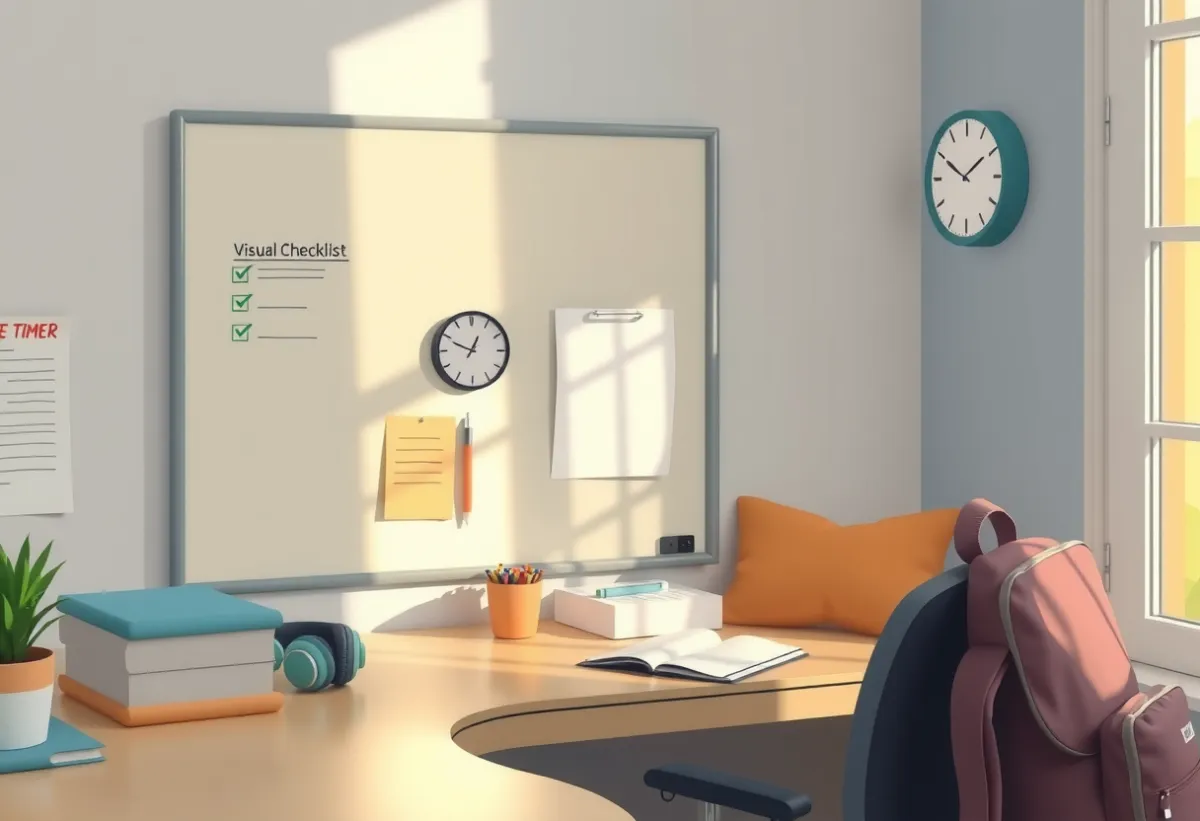
What helps: Visual checklists posted where they'll see them—not verbal reminders shouted from downstairs. Clothes laid out the night before. Same wake time every day, including weekends. (Yes, really. The inconsistency is what kills the routine.)
For neurodivergent teens: Analog clocks help them "see" time passing—digital clocks show a static number that doesn't convey movement. Timers with warnings ("10 minutes left," then "5 minutes left") work better than a single alarm. Reduce choices wherever possible—fewer decisions means less friction.
2. After-School Landing
Where it breaks down: The transition from a high-stimulation school day to home. No clear "what now." Immediate pressure to start homework when their brain is fried.
What helps: Built-in decompression time—not as a reward, but as a scheduled part of the routine. A predictable sequence before homework starts (snack, movement, quiet time, then work).
For neurodivergent teens: Sensory reset first. This might be food, physical movement, noise-canceling headphones, or just 20 minutes alone. Trying to force task initiation before their nervous system has regulated is a losing battle. Let the reset happen, then start.
3. Evening Shutdown
Where it breaks down: Screen hyperfocus with no natural stopping point. "Just five more minutes" spiraling into an hour. No transition cues between awake-time and sleep-time.
What helps: A consistent wind-down time (not just a bedtime). Phone charging station outside the bedroom. Same sleep time every night—even when they insist they're not tired.
For neurodivergent teens: External cues matter more than internal ones. Dimming lights, a parent check-in, a visual countdown timer—these provide the transition signals their brain isn't generating on its own. Don't rely on them to "feel" when it's time to stop. Build the cue into the environment.
How to Re-Teach Routines Without a Power Struggle
Here's where things usually go sideways: you see the routine has collapsed, so you try to fix it. But the way you frame it determines whether your teen engages or shuts down.
Don't frame it as "you forgot everything." Frame it as "we're resetting together." This isn't about blame. It's about acknowledging that breaks disrupt everyone, and now you're rebuilding.
Keep it mechanical, not emotional. Checklists over lectures. Timers over nagging. The less it feels like a conversation about their failures, the more likely they are to cooperate.
Let them have input on how, not whether. The routine is non-negotiable. But they can choose the order, the tools, the music they listen to while doing it. Autonomy within structure reduces resistance.
Start before school resumes if possible. Even 2-3 days of practice makes a difference. Adjust sleep times gradually. Run through the morning routine once. It won't be perfect, but it won't be a cold start either.
You're not being controlling. You're providing scaffolding while their brain catches up.
Tools That Actually Help (Not Just More Apps)
There's no shortage of apps promising to fix executive function. Most of them become one more thing to ignore.
Here's what actually tends to work:
Visual schedules — posted, not just verbal. A whiteboard on the wall, a checklist on the bathroom mirror, a laminated card in their backpack. Something they can see without having to remember.
Timers with warnings — "10 minutes left" matters more than "time's up." Transitions need runway. A visual timer (like a Time Timer) shows time shrinking, which helps with time blindness.
Checklists they can physically check off — there's a real dopamine hit in completion. Crossing something off a list provides the reward signal that neurodivergent brains often don't generate internally.
Analog clocks — digital clocks show time as a static number. Analog clocks show time moving, which helps teens (and adults) understand where they are in relation to a deadline or transition.
Consistent start times — homework at 4pm every day beats "when you feel like it." Predictability removes the decision and the negotiation.
External structure isn't a crutch. It's how executive function develops. The scaffolding comes first; the internalized skill comes later.
What If Last Semester Was Rough?
Maybe fall didn't go well. Grades slipped, routines collapsed, mornings became battlegrounds. And now you're staring down a new semester wondering if anything will be different.
Here's the good news: January is a natural reset point. You don't have to pretend last semester didn't happen, but you also don't have to relitigate it. Focus forward.
Ask yourself: what was the one thing that broke down most often? Not the five things. The one thing. Start there.
If mornings were chaos, focus on mornings. If homework never happened, focus on the after-school routine. If sleep was a disaster, focus on evening shutdown.
Small wins rebuild confidence faster than overhauls. Your teen needs to feel like success is possible before they'll buy into a bigger system.
You don't have to fix everything at once. You just have to fix the thing that's causing the most friction.
Routines Aren't the Goal—Capacity Is
Let's be clear about what we're actually building here.
The goal isn't a perfectly executed morning. It's not a flawless homework routine or a screen-free evening that looks like a stock photo.
The goal is building your teen's capacity to manage themselves—before the stakes get higher. Before college, before a job, before they're living somewhere without you to provide the structure.
Structure now means less scaffolding later. The routines you're building aren't about control. They're about giving your teen a foundation they can eventually own for themselves.
You're not micromanaging. You're building the bridge.
And that's life prep—not the Pinterest version, but the real kind. The kind that actually helps.
If you're looking for a practical starting point—something that builds routine without the power struggle—Life Prep Curriculum has resources designed for exactly that. Executive function support that meets your teen where they are.
I'm not here to convince you. I'm here to make this easier.
