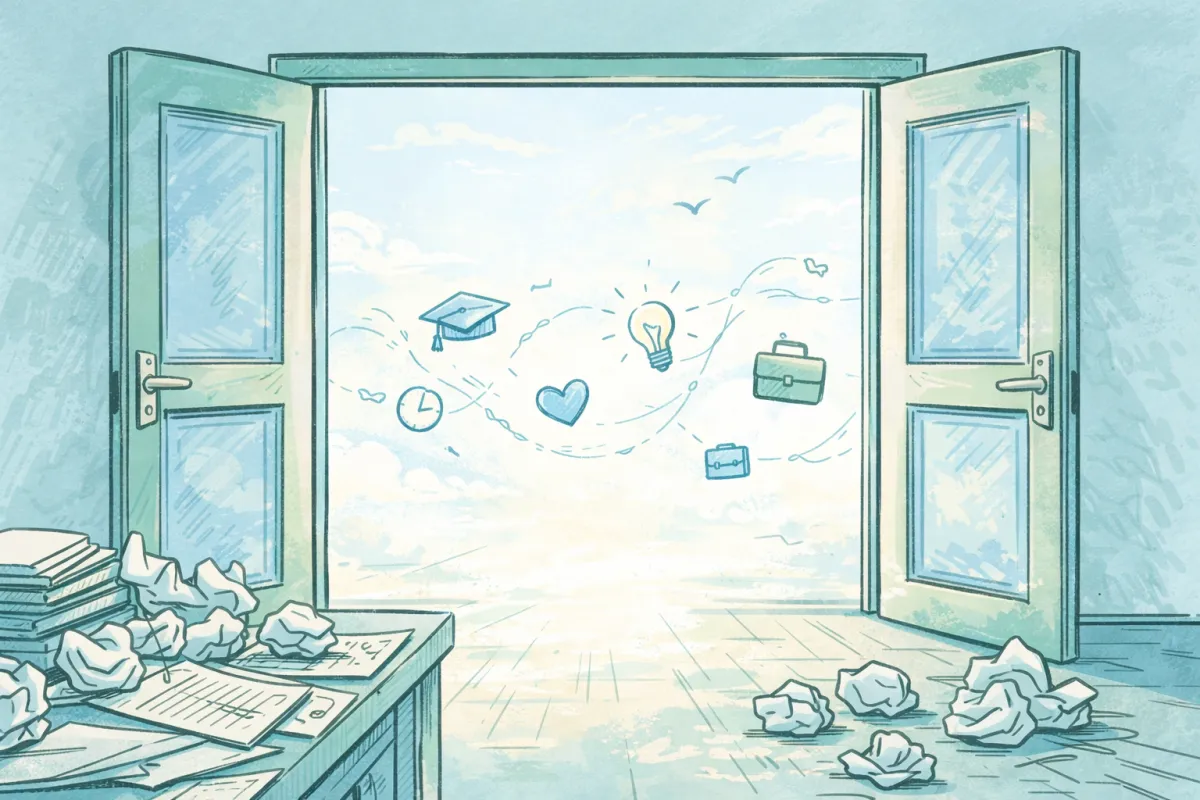
Career Readiness Without the Panic: Helping Teens Explore Futures
The Question That Creates More Anxiety Than Clarity
"What do you want to be when you grow up?"
It starts as a cute question for kindergartners. Firefighter. Astronaut. Veterinarian. The answers are adorable, and nobody takes them too seriously.
By high school, the same question becomes a pressure cooker.
Pick a major. Choose a path. Decide your future—now, at 17, before you've had a chance to actually experience any of it. The college applications want an essay about your life's purpose. The guidance counselor wants a four-year plan. Everyone wants to know "what's next" as if the answer should be obvious.
Here's the reality: fewer than one-third of teens report feeling truly prepared for ANY post-high-school pathway. Not just college. Any path at all. They're being asked to make major life decisions while feeling completely unequipped to make them.
No wonder the question creates anxiety instead of excitement.
Here's what I want you to consider: career readiness isn't "pick a job title by 17." It's learning how to explore, test, and pivot across many possible paths over time.
The goal isn't certainty. It's curiosity with a direction.
What "Career Readiness" Actually Means (It's Not What You Think)
Let's redefine the term, because the way it gets used creates most of the panic.
Career readiness isn't having a specific job picked out. It's having the foundation to navigate whatever comes: self-awareness about what energizes you and what drains you, exposure to different kinds of work so you know what's out there, and a starter set of transferable skills that matter in any path.
Think of it as "learning about work, through work, and at work"—not picking a destination before you've seen the map.
The skills that actually matter? Communication. Problem-solving. Adaptability. Knowing how to learn new things. Financial literacy. Time management. These transfer across every career path—college, trades, military, entrepreneurship, direct-to-work. They're the foundation that makes everything else possible.
So why does the current model create so much panic?
Because it treats career readiness as a decision instead of a process. "Have it all figured out" pressure starts in middle school and intensifies through high school. College gets framed as the only legitimate path, even though many graduates report feeling underprepared for actual work and needing additional training anyway.
The result? Teens feel anxious about a decision they're not equipped to make, based on information they don't have yet, for a future that will probably change anyway.
That's not preparation. That's manufactured stress.
College Isn't the Only Option (And That's Good News)
Somewhere along the way, "What are you doing after high school?" became code for "Which college are you going to?" As if those were the same question.
They're not.
The full menu of post-high-school options is much bigger than the college conversation suggests:
Four-year college—still a valid path for certain fields, especially those requiring specific credentials (medicine, law, engineering, education). But it's one option, not the default.
Community college—lower cost, transfer pathways, career-focused programs, and time to figure things out without massive debt.
Trade schools and technical programs—skilled trades, healthcare certifications, technology training. Often shorter, more affordable, and leading directly to in-demand jobs.
Apprenticeships—earn while you learn, especially strong in skilled trades and emerging industries. No debt, real experience, and a job waiting at the end.
Military service—training, education benefits, career paths, and structure for those who thrive in that environment.
Direct-to-work—entry-level roles with growth potential, stackable credentials earned over time, building a career through experience rather than degrees.
Gap year—structured exploration, work experience, travel, volunteering. Building maturity and clarity before committing time and money to any path.
Interest in these alternatives rises sharply when students actually learn what they involve and see real examples. The problem isn't that teens don't want options, it's that they often don't know the options exist.
A reality check on college: A degree opens doors in certain fields. But employers increasingly value demonstrated skills and experience alongside (or instead of) credentials. The question isn't "college or not?" It's "right fit, right timing, right purpose."
Here's what reduces the emotional load: normalizing that paths zigzag. Most adults change careers, add certifications, or return to school later. The decision at 18 isn't permanent. It's a starting point. High school is a lab for testing interests, not a final exam on life.
Building the Foundation: Self-Discovery Before Decisions
Before talking applications or majors, teens need two things: inner clarity and outer awareness. Without both, any path they choose is a guess.
Self-Discovery Work
Help your teen identify what they actually care about—not what they think they should care about. What are their interests? Strengths? Values? What kind of work environment sounds appealing versus draining?
This doesn't require expensive assessments. Simple tools work: journaling prompts, interest inventories, conversations about what they enjoy and why. The goal is that they can describe what energizes them and what doesn't, in their own words, not career-counselor jargon.
Connect school subjects and hobbies to real job families. A love of gaming doesn't just mean "game designer"—it maps to programming, graphic design, marketing, broadcasting, esports management, community building, and more. Help them see the range.
Expanding "Opportunity Knowledge"
Most teens only know about a narrow set of jobs, the ones their parents have, the ones on TV, the handful mentioned in school. That's a tiny slice of what's actually out there.
Structured exposure broadens their sense of what's possible. Career databases, day-in-the-life videos, local employer spotlights, pay range research. The key question to explore: "What does someone in this field actually DO all day?"
This isn't about picking a winner. It's about expanding the menu so they know what they're choosing from.
Mindset: Curiosity Over Commitment
The question "What do you want to be?" implies permanence. A better question: "What problems do you want to help solve?" or "What kind of work sounds interesting enough to try?"
Emphasize experiments and try-outs over irreversible decisions. Frame exploration as data-gathering: "I'm not deciding yet—I'm learning what I like and don't like." Every experience provides information, even the ones that don't work out.
Low-Pressure Career Exploration (That Actually Works)
Here's where it gets practical. Three levels of exploration, each with different commitment levels and different kinds of learning.
1. Learning ABOUT Work
This is exploration with zero commitment—just information gathering.
Research roles via career websites, YouTube interviews, and virtual job shadows. Have your teen reach out to adults they know for informational interviews: "Can I ask you about your job for 15 minutes?" Most people are happy to talk about their work when asked respectfully.
Clubs, competitions, and service projects also count—SkillsUSA, DECA, robotics, debate, youth media, volunteer organizations. These give a taste of different fields without long-term commitment.
2. Learning THROUGH Work
Part-time jobs, internships, job shadowing, volunteering. The specific role matters less than what they learn about themselves in the process.
Every work experience provides data: "I liked the teamwork. I hated the customer-facing part. I need variety, not repetition. I work better with clear instructions than ambiguity." This is career exploration through direct experience—priceless information that no assessment can provide.
If formal internships aren't available, get creative. Partner with local businesses for short experiences. Ask family friends if your teen can shadow them for a day. Create project-based work that solves real problems.
3. Learning AT Work
For teens who are ready, apprenticeships and entry-level roles offer the chance to earn while they train. This is especially strong in skilled trades and emerging industries where credentials can be stacked over time.
Stackable credentials, certificates, industry badges, certifications, let them build a career step by step without massive upfront investment. Start somewhere, add skills, advance. It's a different model than "go to school, then start working," but it's equally valid and often more practical.
Tools and Language That Reduce the Pressure
Practical frameworks you can use immediately. No career counselor required.
Simple Planning Tools
Try a "Career Curiosity Map"—one page with three columns: interests they want to explore, possible careers connected to each, and one small next step for each option. Not a 10-year plan. Just: "What's one thing I could try or learn more about in the next three months?"
Many states have online career planning tools that show pathways aligned to interest areas. These can help teens see how different courses and experiences connect to different career directions without requiring commitment.
Focus on Transferable Skills
Communication. Teamwork. Time management. Problem-solving. Financial literacy. These matter in every path: college, trades, military, entrepreneurship, direct-to-work.
Help your teen connect current responsibilities to these competencies. That group project? Teamwork and communication. The part-time job? Time management and customer service. Managing their own schedule? Executive function skills that transfer everywhere.
They're already building career skills. Help them name it.
Better Questions to Ask
The questions adults ask shape how teens think about their futures. Small shifts make a big difference.
Instead of: "What are you going to be?"
Try: "What are you curious to learn more about this year?"
Instead of: "You have to pick a major."
Try: "Let's line up a few experiences so you can see what feels like a good fit."
Instead of: "What's your plan?"
Try: "What's one thing you'd like to try or rule out?"
These questions invite exploration instead of demanding answers. They create space to think without triggering defensiveness.
When a Teen "Isn't Ready"
Some teens aren't ready at 18. That's not failure, it's honesty.
Pushing reluctant students into expensive programs they're not prepared for wastes money and damages confidence. A teen who drops out of college after a semester hasn't just lost tuition, they've often lost belief in themselves.
Normalize gap years, bridge programs, and extra time for skill-building. Frame this as strategic—building maturity, independence, and clarity before making big investments—not as falling behind.
"Not ready yet" is different from "not going anywhere." Help them see the difference. A year of working, exploring, and growing up is often worth more than a year of expensive confusion.
The Goal Is Readiness, Not Certainty
Let's be clear about what we're building here.
Career readiness isn't knowing exactly what you'll do for the next 40 years. It's having enough self-awareness, enough exposure, and enough transferable skills to navigate whatever comes.
The path will change. Most careers that exist today didn't exist 20 years ago. The jobs your teen will eventually have might not exist yet. What won't change: the ability to learn, adapt, communicate, solve problems, and figure out what comes next.
Your teen doesn't need to have it all figured out. They need to know how to figure it out—one experiment, one conversation, one experience at a time.
That's preparation for adulthood that actually holds up. Not a specific plan that becomes obsolete. A foundation that works no matter where the path leads.
That's life prep—not the pressure-cooker version, but the real kind. The kind that builds confidence instead of anxiety.
If you're looking for ways to build career readiness without the panic—practical exploration tools, transferable skill development, and real-world preparation that doesn't require picking a path at 17—Life Prep Curriculum has resources designed for exactly that. Skills that matter in every path. Built for buy-in, not pressure.
I'm not here to convince you. I'm here to make this easier.
