Homeschool Kindergarten Day in the Life: Real Learning
When your kindergartner doesn’t fit typical lessons, even an ordinary day can leave you wondering, “Does this count?” Without completed pages to show for it, the question can follow you around like a cloud.
I spent years teaching and writing high school curriculum before homeschooling my own kindergartner. My version of a homeschool kindergarten day in the life now includes a different kind of planning: noticing what happens beyond the lesson.
Sometimes that means pineapple and a plastic knife. Sometimes it means monster toys, traffic-light colors, or materials being taken apart.
These are real moments from our life, not a single day’s timetable. Each gives me something to notice—and a reason to be careful about what I claim.
Why We Don’t Follow a Kindergarten Schedule (and What We Do Instead)
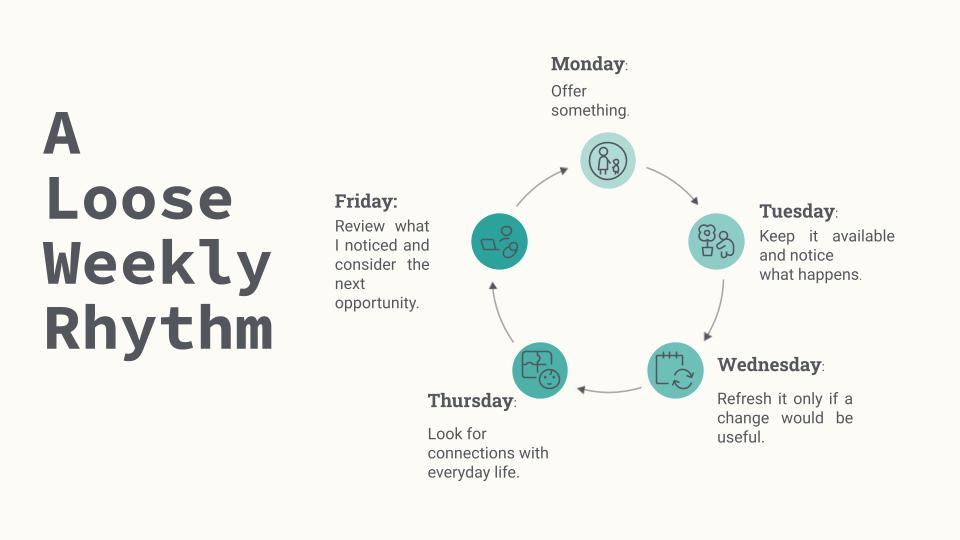
We use a loose weekly rhythm rather than a timetable that tells every part of the day where to go.
It gives me a place to begin without making every invitation something we have to finish.
Monday: Offer something.
Tuesday: Keep it available and notice what happens.
Wednesday: Refresh it only if a change would be useful.
Thursday: Look for connections with everyday life.
Friday: Review what I noticed and consider the next opportunity.
That rhythm is a planning tool, not a record of what my child accomplished. Setting something out tells me what I offered, not what he learned.
I can still plan, explain, demonstrate, and teach directly. I just don’t want the plan to become more important than the child using it.
If something is working, there’s no need to replace it because Wednesday arrived. If it goes untouched, I don’t need to add it to a catch-up list.
The question becomes, “What would be useful next?” rather than, “How do we get back on schedule?”
Our rhythm supports our family. It doesn’t need to run our day.
Morning: Pineapple, a Plastic Knife, and Real Kitchen Skills
One recorded moment was simple: my son cut soft pineapple with a plastic knife on a paper plate.
That description doesn’t need much decoration. He handled a tool, made cutting motions, and took part in preparing food.
It gives me something concrete to notice without turning snack preparation into a whole math lesson.
There could be an opening to talk about pieces, sizes, or halves. But a possible conversation isn’t the same as one that happened.
I can’t write that he understood fractions because pineapple was cut into smaller pieces. I also can’t use that moment to claim independent kitchen safety.
Those things remain separate from what I actually saw.
This is part of what homeschool kindergarten looks like at our house: ordinary activities, described honestly.
I don’t need to interrupt every useful moment with questions. I can let the activity matter on its own, then decide whether another opportunity would help.
For my notes, “cut soft pineapple with a plastic knife” is more useful than “did math and life skills.” It tells me what happened.
Midday: Monster Toys, Sorting, and Storytelling
Another observation was that he played with MrBeast monster toys.
That is the whole recorded observation. It doesn’t tell me whether he sorted them, compared their features, or told a story.
Those are possibilities I can watch for—not achievements I can add afterward.
During another play session, I might notice whether he:
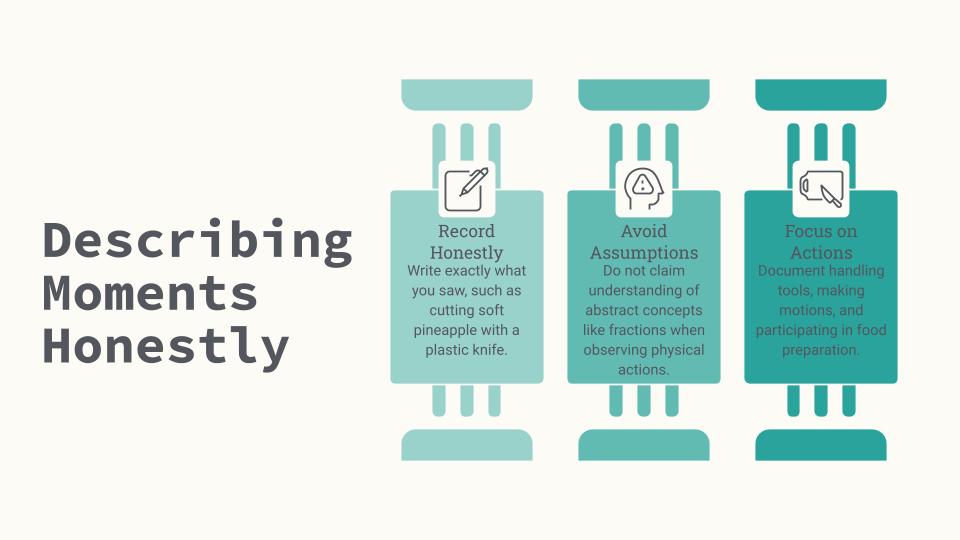
Connects a creature’s features to a familiar animal.
Matches colors or compares differences.
Groups toys in a way I can describe.
Talks about wings or flying.
Narrates events or develops pretend play.
Not every possibility will appear every time. He might use the toys in a way I hadn’t considered.
If he groups them, I can describe the grouping. If he explains his choice, I can save his words.
If he doesn’t, I don’t need to supply an explanation for him.
The toys give us possibilities. His actions give me information.
That distinction helps me enjoy the play without making it carry a list of learning claims. I can be interested in what he’s doing without turning every move into a question.
In the Car: Naming Traffic-Light Colors
While Dad drove, my son correctly named or confirmed the traffic-light colors.
It was a small moment in a real setting, away from a worksheet or a prepared activity.
What did it show? Recognition of the colors and communication about them.
What didn’t it show? That he understood traffic rules or could cross a road safely.
Even “named or confirmed” matters here. Naming a color and confirming one someone else named aren’t identical actions.
The record doesn’t separate them further, so I shouldn’t either.
I don’t need to make the observation sound bigger. It already tells me something useful.
I can save what was recorded and leave the rest open. On another occasion, I might hear him name a color without a prompt.
That would be another observation, not a detail to add backward to this one.
Afternoon: Tools, Styrofoam, and Problem-Solving
Another recorded activity involved a saw, hammer, pliers, and Styrofoam. He used the tools to take apart and explore the material.
There was something concrete to notice: tool actions and changes to a material.
It also gave me a place to look more closely at problem-solving. What action did he try, and what changed afterward?
The record doesn’t include that level of detail. I won’t invent a sequence or say he tried several solutions until one worked.
I also won’t describe the supervision or setup, because those details weren’t recorded.
This is an observation, not an activity recommendation. Tool safety needs its own attention; using a tool doesn’t demonstrate safe technique.
That limit belongs beside the observation, not hidden beneath an impressive list of possible skills.
For me, this is where “noticing” becomes more careful than simply calling everything educational. I want to distinguish what happened, what it might invite next, and what I still don’t know.
How I Record a Day Like This in Two Minutes
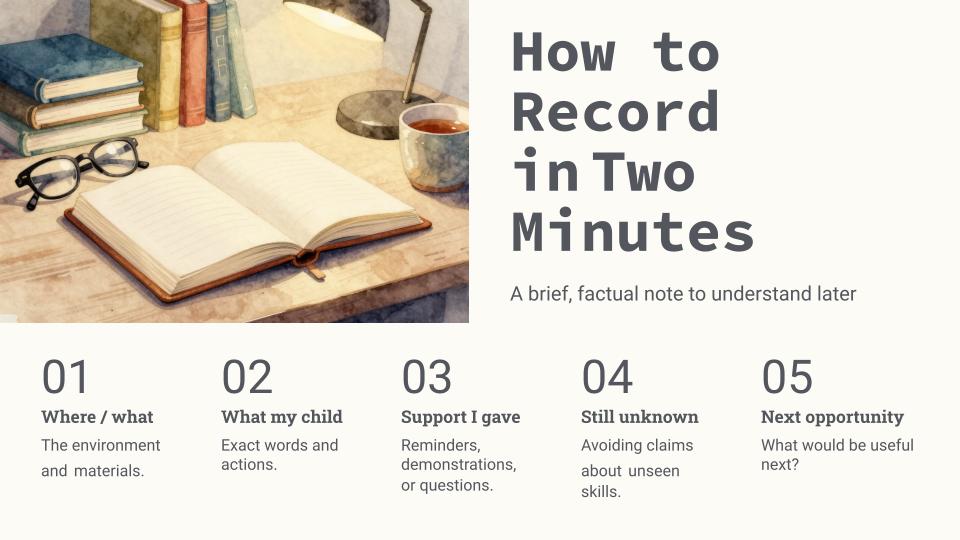
I don’t want recording to become another full-time job.
My aim is a brief, factual note I can understand later. I’m not trying to capture every action or fill every subject box.
For a homeschool kindergarten day in the life, one small observation can be enough to save.
Here is the pineapple moment in the note format I use. The verification markers show what wasn’t recorded.
A quick note to save
Date: October 4th
Where / what was out: Soft pineapple, a plastic knife, and a paper plate; kitchen table.
What my child did or said: Cut soft pineapple with a plastic knife on a paper plate. Exact words, if any.
Support I gave: Holding plate still, remind to watch his fingers.
Still unknown: Understanding of fractions; independent kitchen safety.
Next opportunity: Cutting in "half" chicken nuggets.
No engagement is not evidence of inability.
The support line matters. If I demonstrated, reminded, or asked a question, I want that included.
So does “Still unknown.” It stops me from treating something I haven’t seen as something my child cannot do.
For a closer look at useful notes, read how to track learning without tests.
What a “Normal” Day Doesn’t Look Like
A normal day doesn’t have to produce a neat row of observations.
There is room for ignored invitations, rest days, and days that are mostly screen time. I don’t need to turn those into a polished learning story.
One recorded example was independent LEGO Jurassic World play on Nintendo Switch.
That tells me he played independently. It doesn’t give me specific choices to describe or a list of skills to claim.
Without those details, I leave the observation there.
Unused invitations are not unfinished work.
That applies to the materials I set out, too. An invitation can stay unused without becoming a debt we carry into tomorrow.
I can reconsider the materials, offer help, teach directly, or leave something alone.
A quieter day doesn’t require me to manufacture evidence. It gives me a reason to keep the record honest and the next step manageable.
Start with your child
I still care about what I offer. I also care about understanding what my child actually does with it.
Follow their interests. Notice what they know. Offer the next opportunity.
If you’re weighing another curriculum, begin with the child who will use it—not just the promises on the sales page.
Download the free 10-question kindergarten homeschool checklist to consider fit, flexibility, and what your family needs before you buy.
