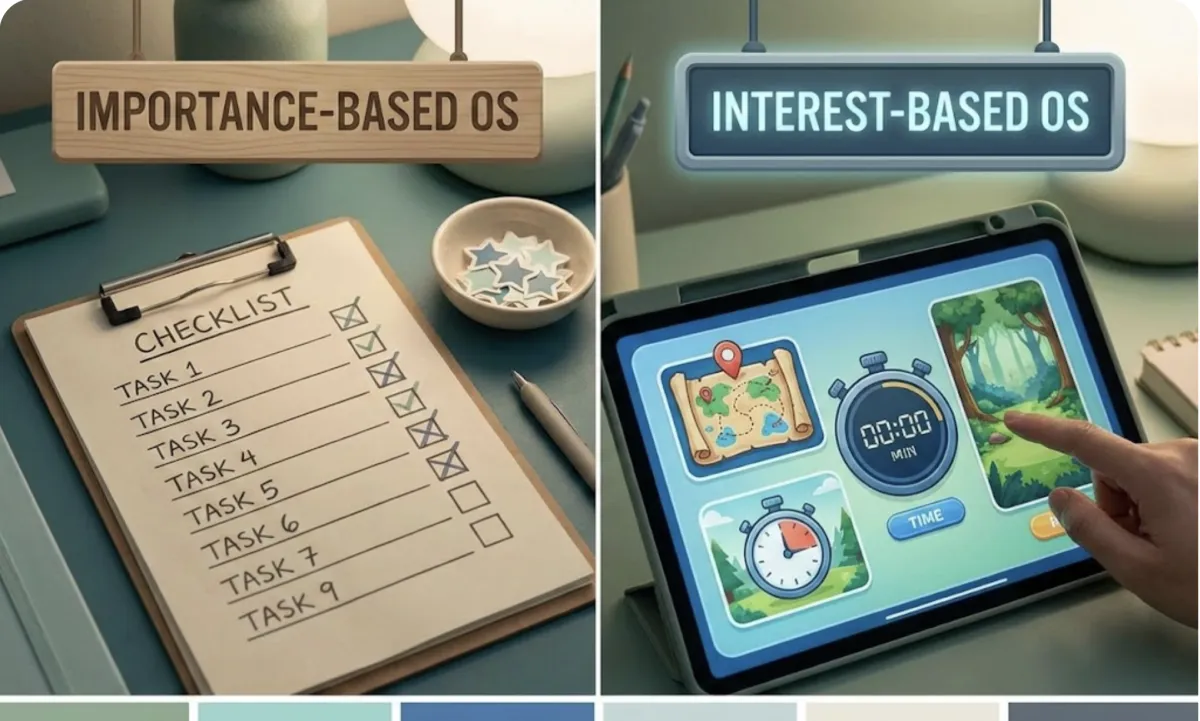
Interest-Based Nervous System: Teaching When Traditional Methods Fail
"If you can play video games for six hours, you can do homework for thirty minutes."
This logic seems airtight. If the brain can focus on one thing, it should be able to focus on another. It's just a matter of choosing. Of trying. Of caring enough.
Except it's not.
And if you've ever watched an ADHD teen sob over homework they genuinely want to finish—homework they understand, homework that matters to them—while being completely unable to start, you already know the logic is broken somewhere.
The breakdown is this: you're assuming all brains run on the same operating system. They don't.
Most brains run on what researchers call an importance-based nervous system. ADHD brains run on an interest-based nervous system. And until you understand that difference, every strategy you try will feel like forcing a square peg into a round hole.
Two Different Operating Systems
The importance-based nervous system.
This is the neurotypical default. It's what most schools, workplaces, and parenting strategies assume.
An importance-based system can prioritize tasks based on:
Importance (this matters, so I'll do it)
Rewards (I'll get something good if I complete this)
Consequences (something bad happens if I don't)
If you have this kind of nervous system, you can look at a task, recognize that it's important, and that recognition generates enough motivation to start and sustain effort. The task doesn't have to be interesting. It just has to matter.
This is why "just do it" works for some people. Why consequences motivate some kids. Why reward charts produce results for some students.
The interest-based nervous system.
ADHD brains work differently.
An interest-based nervous system isn't motivated by importance, rewards, or consequences—at least not reliably. Instead, it's activated by:
Interest (this is genuinely fascinating to me)
Novelty (this is new and different)
Challenge (this is hard in an engaging way)
Urgency (this has to happen right now)
Dr. William Dodson, who coined the term, adds passion and play to this list. The common thread: these are things that engage the brain intrinsically, not through external pressure.
When one of these elements is present, an ADHD brain can focus intensely—sometimes to the point of hyperfocus, where hours disappear and basic needs get ignored. When none of these elements are present, the brain struggles to generate any engagement at all.
This is why the same teen who can't start a five-minute chore can spend an entire day absorbed in a project they care about. It's not about the time. It's not about the difficulty. It's about what activates their particular nervous system.
Why this distinction matters.
Here's the thing: most strategies for motivation, productivity, and learning assume an importance-based system.
"You need to do this because it's important."
"Think about the consequences if you don't."
"You'll get a reward when you finish."
For importance-based brains, these work. For interest-based brains, they often don't—or they work inconsistently, or they work once but not again.
When these strategies fail, we tend to assume the problem is the person. They're not trying hard enough. They don't care enough. They're lazy or defiant or unmotivated.
But if you're running the wrong operating system, no amount of effort fixes the mismatch.
The PINCH Framework
There's an acronym that helps remember what activates an interest-based nervous system: PINCH.
P – Passion (and Play)
When something connects to genuine passion—a topic they love, an activity they'd choose freely—engagement comes naturally.
Play matters too. Turning tasks into games, adding elements of fun, making things enjoyable rather than purely functional. Interest-based brains thrive when work doesn't feel like work.
I – Interest
Interest is slightly different from passion. Passion is deep, long-term, identity-connected. Interest can be more temporary—a topic that catches attention, an angle that's surprisingly fascinating.
The question isn't "how do I make them interested in this?" It's "what angle of this might genuinely interest them?" There's usually something, if you're willing to look.
N – Novelty
New things capture attention. New approaches, new tools, new environments, new ways of presenting familiar information.
This is why systems often work great for two weeks and then stop working. The novelty wore off. The system isn't wrong—it's just no longer new.
For interest-based brains, building in regular novelty isn't a luxury. It's a necessity.
C – Challenge (or Competition)
Challenge engages the brain when it's the right level—hard enough to be interesting, not so hard it's overwhelming.
Competition works for some (competing against others, competing against yourself, gamified progress tracking). For others, the challenge itself is enough.
H – Hurry (Urgency)
This is the one everyone recognizes, usually negatively.
Interest-based brains often can't generate motivation until something is urgent. The deadline is tomorrow. The consequences are imminent. Suddenly, focus appears.
This isn't laziness or poor planning. It's a nervous system that requires urgency to activate. The problem is that real urgency is stressful and often comes too late for quality work.
The strategy isn't to eliminate urgency—it's to create it intentionally and earlier.
Why This Changes Everything About Teaching
If you're a parent or educator working with interest-based learners, this framework changes your entire approach.
Stop leading with importance.
"This will matter someday" doesn't activate an interest-based system. Neither does "you need this for college" or "real adults have to do things they don't want to do."
These statements might be true. They're just not motivating for this kind of brain.
Instead of leading with why it matters, lead with what might make it interesting, novel, challenging, or urgent.
Stop relying on consequences.
Consequences work poorly for interest-based nervous systems—especially distant consequences. The threat of a bad grade in three weeks doesn't generate motivation now. The possibility of struggling in adulthood doesn't make homework feel doable tonight.
This isn't a failure of caring. It's a nervous system that doesn't translate distant consequences into present activation.
Stop expecting consistency.
Interest-based systems are inconsistent by nature. Motivation that exists on Tuesday might be absent on Thursday. A strategy that worked last month might not work this month.
This inconsistency frustrates everyone—the student, the parent, the teacher. But expecting consistency from a system that doesn't produce it just creates shame.
Instead: expect variability. Plan for it. Build flexibility into your expectations.
Practical Strategies That Work With the System
Okay, so what do you actually do?
Make it interesting (for real).
This doesn't mean making everything fun or entertaining. It means finding genuine angles of interest.
Some approaches:
Connect content to topics they already care about
Let them choose how to demonstrate learning
Find the weird, unexpected, counterintuitive parts of the material
Use real-world applications that matter to them specifically
"For real" matters here. Forced enthusiasm or manufactured fun usually backfires. Interest-based brains can smell inauthenticity.
Build in novelty intentionally.
Change locations (kitchen table this week, coffee shop next week)
Rotate tools and methods
Adjust routines before they become stale
Introduce new elements just as old ones lose their shine
Novelty doesn't have to be dramatic. Small changes can refresh a system that's grown stale.
Use strategic urgency.
Since urgency activates the system, create it deliberately rather than waiting for real deadlines to force it.
Shorter timers ("let's do 15 minutes, then check in")
Artificial deadlines ("I need this section by 3pm")
Body doubling (someone else working nearby creates gentle accountability)
External commitments (telling someone else what you'll complete by when)
The goal is urgency without panic. Enough pressure to activate, not so much it overwhelms.
→ Download the free Life Skills Progress Tracker to identify which executive function skills need the most support.
Leverage challenge thoughtfully.
Break tasks into smaller challenges with clear finish lines
Add elements of competition where it's motivating (not everyone finds competition helpful)
Track progress visually so the "challenge" of completion becomes tangible
Adjust difficulty—too easy is boring, too hard is paralyzing
Allow passion to drive when possible.
This is where school and life skills often diverge.
School requires learning specific content on specific timelines. Not everything can follow passion.
But wherever there's flexibility—in projects, in how learning is demonstrated, in what gets prioritized—let passion lead. The engagement difference is dramatic.
→ See also: The Ultimate Life Skills Checklist for High School Success
What This Means for Life Skills Education
Here's why I think about this constantly: most life skills curricula are built for importance-based systems.
"You need to know how to budget because it's important."
"Doing laundry is a necessary life skill."
"Learning to cook will matter when you're on your own."
These statements are all true. They're also motivationally useless for interest-based learners.
If the curriculum leads with importance and relies on compliance, it will fail these students. They won't engage. They won't retain. And everyone will conclude they just don't care about being prepared for adulthood.
They do care. The instruction isn't designed for how their brain works.
What works instead:
Start with scenarios that feel urgent or relevant now
Build in choice and autonomy at every level
Create challenges with clear, immediate feedback
Use novelty in delivery (not just worksheets)
Connect skills to existing interests whenever possible
Design for engagement first, content second
This is harder than designing for compliance. It takes more thought, more flexibility, more willingness to throw out what isn't working.
But it's the only thing that actually works for interest-based learners.
→ The Executive Function Skills Bundle is designed with these principles—building self-advocacy and SMART goals through engagement, not compliance.
For Parents: Working With Your Teen's System
If your teen has an interest-based nervous system, you've probably already discovered that most parenting advice doesn't land.
Accept that it's different, not deficient.
Their brain works differently. Not worse—differently. The strategies that work for their siblings or classmates won't necessarily work for them.
This isn't an excuse or a limitation. It's a starting point for finding what actually helps.
Stop fighting the operating system.
You can't willpower your way into a different nervous system. Neither can they.
The energy spent trying to make an interest-based brain function like an importance-based one is wasted. Redirect it toward working with the system they have.
Help them understand themselves.
The most powerful thing you can give an interest-based learner is self-understanding.
When they know why certain things are hard—and that it's neurology, not character—they can stop blaming themselves and start problem-solving.
"I can't focus on this because it's boring and there's no urgency. What can I add to create engagement?"
That's a different question than "What's wrong with me that I can't just do this?"
→ The Self-Advocacy Communication Mini-Lesson teaches teens how to articulate their needs—including how their brain works differently.
Collaborate on strategies.
They know their brain better than you do. They know what's worked before, what felt impossible, what made something suddenly doable.
Instead of imposing strategies, experiment together. Try things. See what happens. Adjust.
The goal is building their capacity to manage their own nervous system—not compliance with your systems.
Let go of "should."
"You should be able to just do this."
"You shouldn't need all these accommodations."
"Everyone else manages without this much support."
Should is irrelevant. What matters is what works.
If they need a timer, a body double, music playing, a change of scenery, a reward at the end—and those things help them function—then those things are valid. Full stop.
The Bottom Line
An interest-based nervous system isn't a broken importance-based system. It's a different system entirely.
When you try to motivate it with importance, consequences, and distant rewards, it doesn't respond—or responds inconsistently, unreliably, insufficiently.
When you work with it—finding genuine interest, building in novelty, creating appropriate challenge, leveraging urgency—it can do remarkable things.
The teen who can't start homework might hyperfocus on a passion project for eight hours. The student who seems lazy might have more capacity for sustained effort than anyone in the room, given the right conditions.
The operating system isn't the problem. The mismatch is.
Understanding that changes everything about how we teach, parent, and support the interest-based learners in our lives.
Related Posts
When Motivation Disappears: Mid-Year Executive Function Reset
Why Your Teen's "Laziness" Might Be Task Paralysis → Feb 25
The Real Reason Life Skills Don't Stick (And What to Do Instead) → Feb 27
