5 Ways Project-Based Learning Bridges Academics and Adulting
The Gap Between School and Real Life
Your teen can analyze a poem. They can identify themes, explain metaphors, write a thesis statement that would make an English teacher proud.
But ask them to make a phone call to schedule their own appointment? Freeze.
They can solve for X. They can work through multi-step equations and show their work. But ask them to budget for a weekend trip with friends? Blank stare.
This isn't a failure of intelligence. It's a gap—between academic knowledge and applied skill. Between what school teaches and what life actually requires.
The education world is starting to catch on. One of the biggest trends in K-12 education for 2025 and 2026 is the push toward real-world, project-based learning—the kind that builds practical skills alongside content knowledge.
But you don't have to wait for schools to figure it out. This is something you can do at home.
What Project-Based Learning Actually Is (and Isn't)
Project-based learning—PBL—is one of those terms that gets thrown around a lot, often attached to things that don't quite fit.
So let's be clear about what it actually means.
PBL is when students tackle a real-world problem or question through research, design, and creation. They're not just learning about something—they're doing something with what they learn. And the outcome matters to someone beyond the teacher.
It's not: a Pinterest craft. A themed worksheet. A "fun Friday" activity tacked onto real learning. A project assigned at the end of a unit to prove students absorbed the content.
It is: extended inquiry. Student-driven. A tangible outcome for a real audience. Learning that happens through the work, not before it.
Why does it work? Because students learn by doing, researching, building, and presenting—not just absorbing information and repeating it back. Research consistently shows that PBL students don't just develop better real-world skills; they actually outperform traditional classrooms academically, including on standardized tests.
Turns out, when learning feels real, it sticks.
Why This Matters More Now
Here's a stat that stopped me: 80% of global employees believe that by 2035, evidence of skills acquired will be valued as much as a university degree.
The world is shifting. Schools are starting to move toward competency-based frameworks that evaluate what students can do, not just what they know. Employers are asking for collaboration, adaptability, problem-solving—the exact skills that don't show up on a transcript.
And the jobs your teen will eventually have? Some of them don't exist yet. Which means memorization matters less than adaptability. Content knowledge matters less than the ability to learn, apply, and pivot.
This isn't about abandoning academics. It's about making academics mean something. Connecting the classroom to the world outside it. Giving your teen a reason to care about what they're learning—because it actually connects to something they'll use.
That's what project-based learning does. And that's why it matters more now than ever.
5 Ways PBL Bridges Academics and Adulting
1. It Makes Relevance Visible
Traditional learning sounds like: "You'll need this someday."
Project-based learning sounds like: "You need this now to solve this problem."
When teens can see the point—when learning connects to something they're actually trying to accomplish—buy-in follows. You don't have to convince them it matters. The project does that work for you.
Example: Planning a family vacation teaches budgeting, research skills, geography, decision-making, and compromise—all at once. And your teen cares because the outcome affects them directly.
2. It Builds Executive Function Through Structure, Not Lectures
Every meaningful project requires planning. Prioritizing. Managing time. Adapting when things don't work the first time.
These are the exact executive function skills that neurodivergent teens—and honestly, all teens—need to develop. And PBL builds them in context, not through worksheets about "how to plan."
External deadlines with real stakes do what nagging can't. When the project matters, the motivation shows up differently.
For neurodivergent teens: Break big projects into smaller "missions" with clear milestones. Visual tracking helps. Celebrate progress, not just completion.
3. It Normalizes Failure as Part of the Process
In traditional school, failure equals a bad grade. Something to avoid. Something that goes on a transcript.
In project-based learning, failure equals iteration. Try again. Refine. Figure out what didn't work and adjust.
This builds resilience and problem-solving in ways that matter long after graduation. Teens learn that "not working yet" isn't the same as "not working ever." They learn that setbacks are data, not verdicts.
That's a life skill. And it's one traditional schooling rarely teaches.
4. It Connects to Real Audiences (Not Just the Teacher)
Something shifts when the audience isn't just a teacher with a red pen.
Presenting to a real audience—parents, community members, a local business, even just family—raises the stakes in a way that feels meaningful. Teens work harder when the outcome matters to someone other than a gradebook.
This mirrors how work actually functions: deliverables, deadlines, stakeholders who care about the result. It's practice for the real world, embedded in the learning.
5. It Integrates Life Skills Without Making Them Feel Like "Extra"
Here's the magic: financial literacy, communication, time management, collaboration—these don't have to be a separate "life skills class." They can be woven into what your teen is already doing.
A mock business project teaches budgeting, marketing, public speaking, and teamwork—simultaneously. A meal-planning challenge teaches research, math, nutrition, and decision-making without ever feeling like a lesson.
This is how real-world skills for students actually develop: not in isolation, but integrated into work that matters.
What This Looks Like at Home (Even Without a Classroom)
You don't need a school to do project-based learning. Homeschool families have been doing this for years. And even if your teen is in traditional school, you can layer PBL experiences at home.
Start with a "driving question"—something open-ended that matters to your teen:
"How could we plan a road trip for under $500?"
"How could I start a small business selling something I make?"
"What would it take to redecorate my room on a real budget?"
Let them research. Let them plan. Let them budget and problem-solve and present a proposal. Your role is guide on the side, not sage on the stage. Ask questions. Offer resources. Resist the urge to take over.
Some practical project ideas:
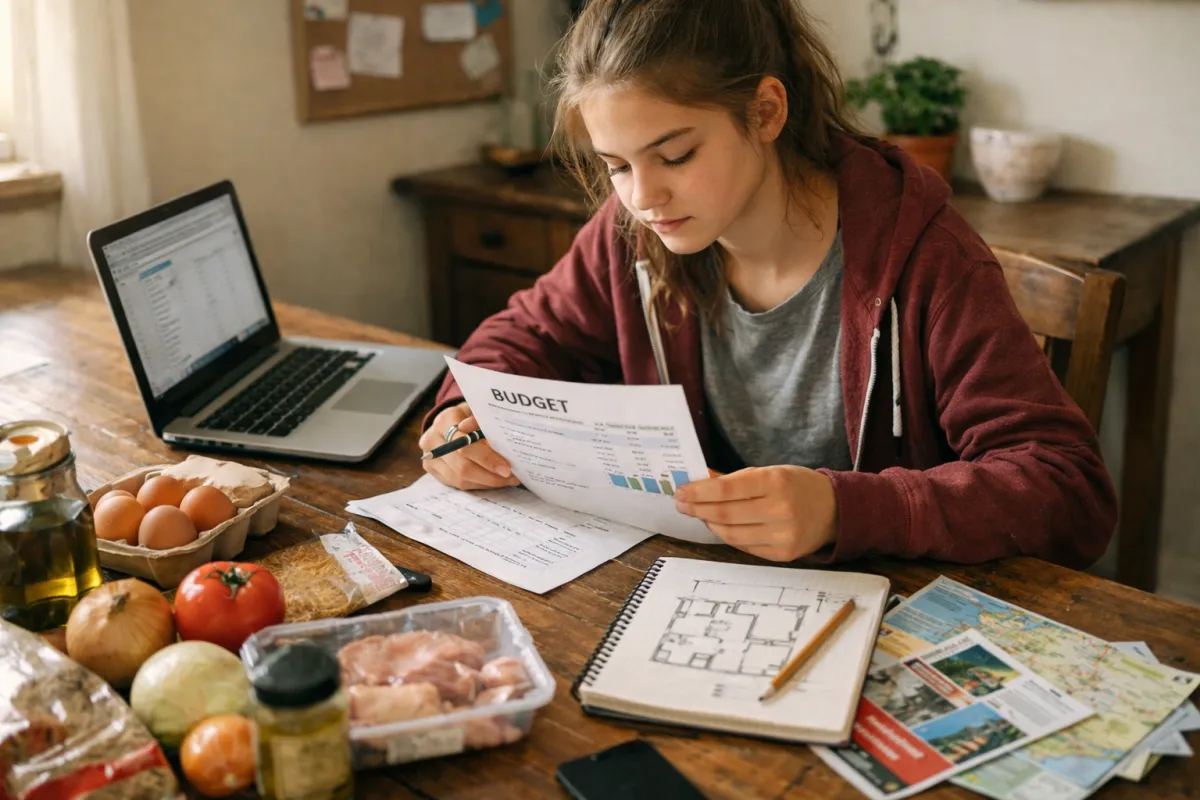
Plan a week of family meals on a budget. Research recipes, calculate costs, shop within a limit, cook at least one meal. Covers math, nutrition, decision-making, and real-world cooking skills.
Research and propose a home improvement project. Measure the space, research materials and costs, create a budget, present a pitch to the family. Covers measurement, budgeting, persuasion, and planning.
Create a small business plan for something they care about. Identify a product or service, calculate startup costs, design basic marketing, present to family as "investors." Covers financial literacy, communication, and entrepreneurial thinking.
For neurodivergent teens: Structure the project with clear phases and visual milestones. Smaller "missions" that build toward a bigger outcome keep things manageable. Celebrate each checkpoint, not just the final product.
The Skills That Transfer
Here's what teens actually walk away with when they complete a meaningful project:
How to break a big goal into manageable steps.
How to research and evaluate information.
How to work with others—even when it's frustrating.
How to present ideas to people who matter.
How to recover when Plan A fails.
These aren't "soft skills." They're survival skills for adulthood. And they're the skills employers, colleges, and life itself will actually require.
The content knowledge matters too—but content without application fades. Skills built through real work stick around.
Academics and Adulting Aren't Opposites
Let's be clear: this isn't about choosing between academics and life skills. It's about doing both—at the same time.
The best education builds knowledge and capacity. It teaches content and application. It prepares teens for tests and for life.
Project-based learning isn't a trend. It's a return to how humans have always learned best: by doing. By making. By solving real problems with real stakes.
You don't have to wait for schools to catch up. You can start at home—with one project, one real question, one chance to see what your teen is capable of when the work actually matters.
That's the bridge between academics and adulting. And you can build it yourself.
If you're looking for a way to bridge academics and real-world skills—without adding another full curriculum to your plate—Life Prep Curriculum has project-based resources designed to do exactly that. Practical. Standards-aligned. Built for buy-in.
I'm not here to convince you. I'm here to make this easier.
