Setting Boundaries for Teens: What Math & Biology Teach About Saying No | Life Prep Curriculum
"Just set a boundary."
You've heard this advice. Maybe you've given it. And it sounds simple—like boundaries are just a thing you decide to have and then everything falls into place.
But if you've ever watched a teen try to set a boundary, you know the reality is messier.
They're terrified of being seen as difficult. They don't want to lose the friendship. They've been told their whole lives to be nice, be flexible, be accommodating.
Here's what I've learned: the problem isn't that teens don't want boundaries. It's that nobody's explained how they actually work.
Turns out, the explanation parallels the academic content they are already learning.
Why Boundaries Feel Impossible
The need for belonging is real. Adolescence is when peer relationships become central. Setting a boundary feels like risking acceptance—because sometimes it is.
The "nice person" trap. Many teens have absorbed the message that being kind means being available. That good people don't have limits.
For some teens, it's even harder. People-pleasing, hypervigilance to others' emotions, rejection sensitive dysphoria—these make boundaries feel genuinely threatening, not just uncomfortable.
So "just set a boundary" lands like "just do calculus." The what is clear. The how is missing.
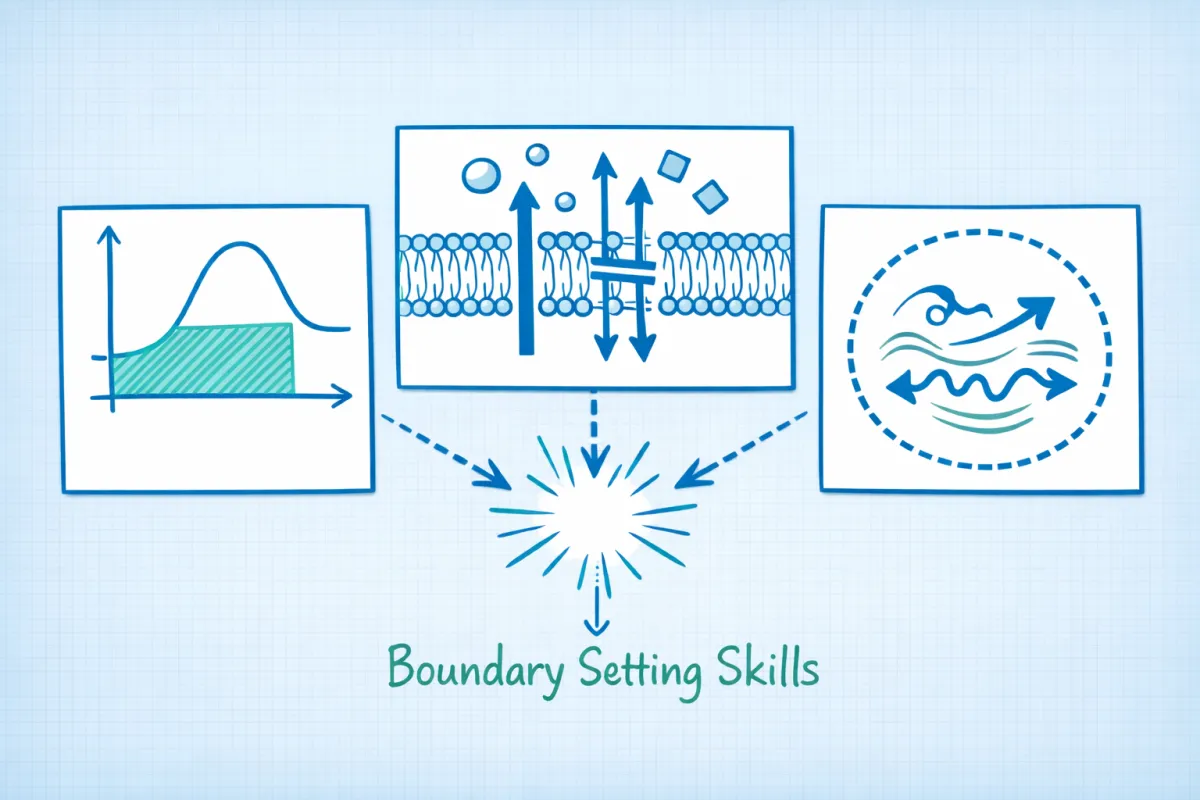
The Framework: Domain Restrictions
Let's start with math.
The concept: Every function has a domain—the set of inputs it can accept. f(x) = √x can't take negative numbers. The domain is x ≥ 0. That's not the function being difficult. It's the function being clear about what works.
The life skill: You have a domain too. Some requests fall outside it—not because you're inflexible, but because accepting them would break something.
Math Example --> Life Parallel
f(x) = √x requires x ≥ 0 --> "I can't stay out past 10 on school nights"
Can't divide by zero --> "I can't lend money I don't have"
Domain: all real numbers except x = 2 --> "I'm available for most things, but not that"
The script that matches:
Math: "This function is undefined at x = 2."
Life: "That doesn't work for me. What about [alternative]?"
Both state a limit clearly. Both offer what IS possible. Neither apologizes for having constraints.
The Framework: Selective Permeability
Now biology.
The concept: The cell membrane doesn't block everything—it's selectively permeable. Nutrients get through. Toxins get blocked. Transport proteins actively decide what gets access.
If the membrane stopped being selective, the cell would die.
The life skill: Healthy boundaries aren't walls. They're filters. You're not shutting everyone out—you're being selective about what you let in.
Biology Example --> Life Parallel
Oxygen passes freely --> Close friends get easy access
Glucose needs a transport protein --> Some requests need more consideration
Toxins get blocked --> Harmful people/behaviors don't get in
Active transport uses energy --> Some boundaries take effort to maintain
The script that matches:
Biology: "The membrane allows small nonpolar molecules through but blocks ions without channel proteins."
Life: "I'm happy to help with homework, but I'm not comfortable sharing my answers to copy."
Both allow some things while blocking others. Both have clear criteria. Both protect what's inside.
The Framework: System Boundaries
Now physics.
The concept: Thermodynamic systems are classified by what their boundaries allow:
Open systems: exchange energy AND matter freely
Closed systems: exchange energy but not matter
Isolated systems: exchange neither
No type is universally "right." It depends on what the system needs.
The life skill: You get to choose what kind of system you are—and it can change based on who you're with.
Physics Example --> Life Parallel
Open system (boiling pot, no lid) --> Sharing freely with your closest person
Closed system (pressure cooker) --> Friendly but keeping some things private
Isolated system (thermos) --> Full protection from someone unsafe
The script that matches:
Physics: "This is a closed system—energy transfers but matter stays contained."
Life: "I'm happy to hang out, but I don't want to talk about what happened with my ex."
Both define what flows and what doesn't. Both are functional, not hostile.
When the System Gets Tested
Here's where it gets real: sometimes people push against your boundary.
In biology terms: Some molecules keep pushing against the membrane, demanding entry. If the membrane let everything through just because something pushed hard enough, the cell would die.
In life terms: Someone who keeps asking after you've said no is testing whether your boundary is real.
Healthy responses to a boundary:
"Oh, I didn't realize. Thanks for telling me." (respects the membrane)
Adjusts behavior going forward (learns the domain)
Maybe brief awkwardness, but no punishment (system recalibrates)
Concerning responses:
"I guess I'm just a terrible friend then." (guilt = pressure on the membrane)
"You're being dramatic." (denies your domain exists)
Keeps asking (repeated assault on the boundary)
Punishes you with silence (retaliation for having limits)
The script when boundaries get pushed:
Math: "The function is still undefined there, no matter how many times you try to input that value."
Life: "I already said no. I need you to hear that."
Building Boundary Tolerance
Like any skill, this gets easier with practice.
Start with low-stakes domains.
Math version: Before you tackle complex piecewise functions, you practice simple linear domains.
Life version: "Actually, I'd rather get pizza than tacos." State a small preference. Tolerate the brief discomfort. Build the muscle.
Practice with systems that won't fail.
Physics version: You don't test thermodynamic principles on a nuclear reactor first. You use controlled environments.
Life version: Practice with someone who can hear "no" without crisis. The skills transfer to harder situations.
Notice what actually happens.
Science version: Run the experiment. Observe the results. Adjust your hypothesis if needed.
Life version: Most of the time, the friend doesn't leave. The world doesn't end. Let that data update your expectations.
For Parents: Supporting the Lab Work
Model imperfect experiments. Let your teen see you set a boundary awkwardly. "That was uncomfortable, but I needed to say it" teaches more than a flawless performance.
Don't run the experiment for them. Help them design it. Maybe rehearse. But let them collect their own data—even if the first trial doesn't go perfectly.
Respect their domain. When your teen sets a boundary with you—about privacy, space, what you share with others—your response teaches them whether their limits are real or negotiable.
A teen who learns their domain matters at home expects it to matter everywhere.
The Bottom Line
Boundaries aren't about being difficult. They're about being functional.
Domain restrictions teach that limits aren't flaws—they're definitions.
Selective permeability teaches that filtering isn't rejection—it's survival.
System boundaries teach that controlling access isn't cold—it's necessary.
Every function has constraints. Every cell has a membrane. Every system has boundaries.
So do you.
The academics provide the framework. Real life provides the practice. Together, they build a skill that works.
Related Posts
STANDARDS ALIGNMENT
Math: CCSS.MATH.HSF.IF.A.1 (domain), HSF.IF.B.5 (real-world constraints)
Biology: NGSS HS-LS1-2 (cell membrane), AP Biology LO 2.11
Physics: NGSS HS-PS3-4 (energy transfer), thermodynamics
Health: NHES Standard 4.12.1-4.12.4 (interpersonal communication, refusal skills)
SEL: CASEL Relationship Skills; ASCA B-SS 1, B-SS 8
Life Prep Curriculum | Standards to Life™ Framework
