How I Build Life Skills Curriculum That Actually Works | Standards to Life™
The Problem with Most Life Skills Curriculum
Most life skills resources start with the life skill and stop there.
They're disconnected from academics—which means teachers can't justify the classroom time and parents feel like it's "extra." One more thing to squeeze in. One more thing that competes with homework and test prep and everything else that feels urgent.
Or they go the other direction: academic content with a life skills label slapped on top. "Real-world math!" the worksheet announces, before asking students to calculate how many pizzas a fictional restaurant needs for a fictional party.
Teens see through it immediately.
The bridge between "what school requires" and "what life demands" doesn't get built. The two worlds stay separate. And teens keep asking the question no one has a good answer for: "When will I ever use this?"
That's the problem I set out to solve. And it starts with a different question entirely.
My starting question: How do I make this academic standard matter to a teen's actual life—and make that connection so obvious they can't miss it?
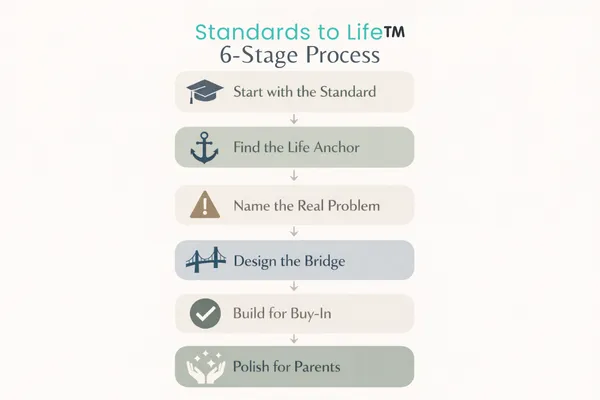
The Standards to Life™ Process
Every product I create goes through six stages. It's not complicated, but it is intentional. Each stage builds on the last, and skipping one usually means the final product doesn't land the way it needs to.
Here's the overview:
Stage 1: Start with the Standard. Identify the academic standard or topic.
Stage 2: Find the Life Anchor. Connect it to a real-world competency domain.
Stage 3: Name the Real Problem. What does this look like when it goes wrong in adulthood?
Stage 4: Design the Bridge. Create the framework that connects knowing to doing.
Stage 5: Build for Buy-In. Structure it so teens want to engage—not just comply.
Stage 6: Polish for Parents. Remove every barrier to implementation.
That's the framework. But frameworks are abstract until you see them in action.
So let me walk you through exactly how this works—using a real example from start to finish.
Stage 1: Start with the Standard
I pick a common academic standard that parents and teachers would recognize. Something that shows up in classrooms across the country.
The standard: CCSS.MATH.CONTENT.7.RP.A.3 — "Use proportional relationships to solve multi-step ratio and percent problems."
In plain English: calculate percentages. Solve word problems about discounts, tax, tips. Show your work. Get graded. Move on.
What this looks like in most classrooms:
A worksheet. Maybe twenty problems. "A shirt is on sale for 30% off. The original price is $45. What is the sale price?" Students calculate. They get it right or wrong. They move on to the next unit.
The gap:
That same teen can calculate 15% of $47.50 on a test. But standing in a store, staring at a "50% OFF!" sign, they can't recognize when the deal isn't actually a deal. The original price was inflated. The "sale" price is what it always costs. The math skill exists—but it lives in isolation. It doesn't transfer to real decisions.
My starting question: Where will this teen actually USE proportional reasoning in their real life? And what would make them care about getting it right?
Stage 2: Find the Life Anchor
This is where the Standards to Life™ framework comes in.
I've mapped out 12 core competency domains that research shows correlate with adult success and life satisfaction. Financial literacy. Health and wellness. Career readiness. Digital citizenship. Relationships. Communication. And so on.
Every academic standard can connect to at least one of these domains. Usually more than one.
For this standard: Proportional reasoning connects directly to Financial Literacy and Consumer Awareness.
Specific life applications:
Evaluating sales and discounts—is this actually a deal? Calculating tips at restaurants. Understanding interest rates on loans. Comparing unit prices while shopping. Recognizing when percentages are being used to manipulate.
The anchor I choose: Spotting spending traps. Specifically, analyzing whether a "deal" is actually worth it.
Why this anchor: It's immediate. Teens encounter sales, discounts, and "limited time offers" constantly—online, in stores, in ads on their phones. The relevance is obvious. The stakes feel real. It's their money. Their decisions.
That's the anchor. Now I need to make them care about it.
Stage 3: Name the Real Problem
Here's what I've learned: teens don't engage with abstract benefits. "This will help you in the future" doesn't land. "This is important for adulting" doesn't land.
What lands? Concrete problems they can picture. Real consequences they want to avoid.
What happens when this skill is missing:
Adults who buy things just because they're "on sale"—whether they needed them or not. People who don't realize 30% off an inflated price is no savings at all. Consumers who can't compare unit prices and consistently overpay for convenience. The person who signs up for "0% financing" without calculating total cost and fees. Impulse purchases justified by "but it was such a good deal."
The real-world cost:
The average American loses over $5,000 a year to impulse purchases. "Sale" pricing is a $300+ billion marketing industry—built entirely on making people feel like they're getting a deal when they're not. Financial regret is consistently one of the top sources of adult stress.
How I frame it for teens: "Companies spend billions of dollars figuring out how to make you think you're getting a deal when you're not. The math you're learning? It's your defense system."
That framing changes everything. Suddenly the math isn't pointless—it's protection. It's power. It's the difference between getting played and making smart decisions.
Teens don't care about "proportional relationships." They care about not getting scammed.
Stage 4: Design the Bridge
This is where the actual framework gets built. The bridge between knowing and doing.
It has three parts.
Part A: The Concept Translation
I translate the academic language into life language, then into teen language.
Academic: "Use proportional relationships to solve percent problems."
Life: "Figure out if this deal is actually worth it."
Teen: "Don't get scammed by fake sales."
Same skill. Different framing. Completely different level of engagement.
Part B: The Skill Breakdown
I break down what a teen actually needs to DO to use this skill in real life. Not on a test. In a store. On their phone. When they're about to click "buy now."
The actions: Identify the original price (or estimate if it's not shown). Calculate the actual discount amount. Compare to alternatives—is this the best price available? Evaluate cost-per-use—will I use this enough to justify the cost? Pause before purchasing—is this impulse or intentional?
Part C: The Memorable Framework
Here's where I create something that sticks. An acronym. A method. Something they'll remember when they need it—not just during the lesson.
The DEAL Check:
D — Discount real? Calculate actual savings. Check if the "original price" is inflated.
E — Elsewhere cheaper? Quick comparison search before buying.
A — Actually need it? Honest need vs. want check.
L — Long-term value? Cost-per-use calculation.
Why acronyms work: Teens won't remember a worksheet. They won't pull out their notes while standing in Target. But they'll remember DEAL when they're staring at a "limited time offer" with their phone in their hand. The framework travels with them.
Stage 5: Build for Buy-In
This is where most curriculum fails.
The content might be solid. The framework might be smart. But the structure kills engagement. It's too long. Too demanding. Too reliant on compliance. Too easy to abandon.
I design everything neurodivergent-first. Not because every teen is neurodivergent—but because what works for neurodivergent learners works for everyone. Clear structure reduces anxiety for all brains. Predictable formats build confidence across the board. Permission-based language creates safety that benefits every learner.
Structure principles:
One clear focus per day. 5-15 minutes max per session. Checkbox completion so progress is visible. Predictable format they can rely on—no surprises, no overwhelm.
Language principles:
"You might try" instead of "you must." "Pick one that fits" instead of "complete all." No guilt for skipped days. Partial completion is still progress. Perfection is never the expectation.
Engagement principles:
Real scenarios they recognize—not "John bought 47 watermelons." Their actual money, their actual decisions. Reflection prompts framed as invitations, not requirements. Space to notice their own patterns without judgment.
Repetition principles:
The same core skill—analyzing deals—gets practiced across multiple contexts throughout the challenge. Day 3: Analyze an online sale. Day 12: Spot marketing tricks in an ad. Day 18: Audit one spending category. Day 26: Evaluate a "good deal" claim in real-time.
By Day 30, the DEAL Check isn't something they have to remember. It's automatic. That's the goal—not knowledge, but automaticity. Skills that fire without conscious effort.
Stage 6: Polish for Parents
The final stage removes every barrier to implementation.
Because here's the truth: the best curriculum in the world doesn't matter if it never gets used. And most resources don't get used—not because parents don't care, but because the friction is too high. Too much prep. Too much teaching required. Too much time.
What parents actually need:
Zero prep required. No teaching expertise assumed. Clear instructions they can hand directly to their teen. Progress they can see without hovering.
What I build:
Complete workbook format—nothing to assemble, nothing to print, nothing to organize. Daily structure that doesn't require parent involvement. Weekly check-ins for optional family conversation. Visual progress tracking built in. Celebration moments that acknowledge growth without feeling forced.
What I remove:
Jargon. Overwhelming length. Perfection expectations. Anything that requires a parent to "teach."
The test I use: Can a tired parent hand this to their teen on a Monday morning and walk away? If yes, it ships. If no, it's not done yet.
The Finished Product
What started as: CCSS.MATH.CONTENT.7.RP.A.3 — "Use proportional relationships to solve multi-step ratio and percent problems."
What it became: A 30-day challenge where teens learn to spot spending traps, analyze deals, and build automatic money decision-making skills. The SMART method as the overarching framework. The DEAL Check as one of the core tools. Daily practice that takes 5-10 minutes. Visual tracking. No perfection required. Skills that stick because they got repeated until they became automatic.
What the teen experiences:
Daily challenges that feel relevant to their actual life. Real examples—not fictional word problems. Visible progress they control. Skills that stick because they practiced them in different contexts, repeatedly, until the response was built in.
What the parent experiences:
Zero prep. No fighting about "life skills lessons." A teen who starts pausing before purchases—without being nagged. Relief that something is actually working.
What the academic standard got:
Real-world application that makes the math meaningful. Context that finally answers "when will I ever use this?" Transfer from classroom skill to life skill. The bridge that was always missing.
Why This Process Works
It's not magic. It's architecture.
Most curriculum fails because it solves the wrong problem—or only solves part of it.
Some curriculum teaches the standard without life connection. Result: teens don't care.
Some curriculum teaches the life skill without academic rigor. Result: educators can't justify the time.
Some curriculum requires too much from parents. Result: it sits on a shelf.
Some curriculum relies on compliance instead of buy-in. Result: it doesn't stick.
The Standards to Life™ process solves all four:
Academic standards are embedded—not abandoned. Life relevance is obvious—not assumed. Parent implementation is effortless—not aspirational. Teen engagement is designed in—not hoped for.
The result? Curriculum that actually gets used. Skills that actually transfer. Teens who actually care.
That's not a tagline. That's the architecture working.
The Bridge Gets Built One Standard at a Time
Every product I create goes through this process. Every academic standard gets connected to real life. Every framework gets tested against the question: "Will a teen actually use this when it matters?"
It takes longer than slapping a worksheet together. It requires thinking through not just what teens need to know, but how they'll actually learn it, why they'll care, and when the skill will show up in their real life.
But it works.
And that's the point.
The gap between school and life doesn't have to stay open. The bridge can get built. It just has to be built intentionally—one standard at a time, one life skill at a time, one framework that actually sticks at a time.
That's what I do. That's how I do it. And now you've seen the whole process.
Want to see this process in action? The 30-Day SMART Money Challenge is the finished product of exactly this methodology—academic rigor meets real-world relevance, designed for buy-in, built for busy families. It's available now on Amazon.
I'm not here to convince you. I'm here to make this easier.
