What Screens Are Teaching Your Teen — And What They're Not
Your teen spent three hours "reading" last night.
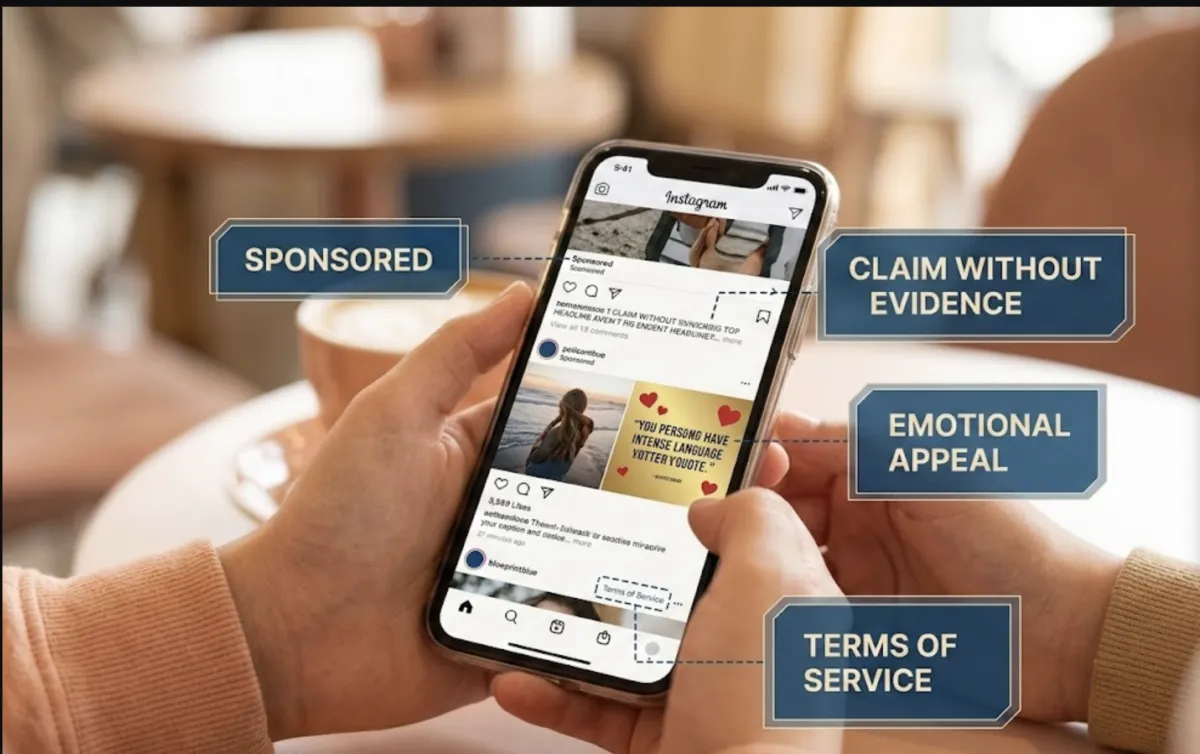
Not a book. A feed. Instagram captions, Reddit threads, YouTube comments, product reviews, Terms of Service they clicked "agree" on without scanning, and a sponsored post they didn't realize was an ad. They consumed more written text yesterday than most adults read in a workday.
And not a single word of it was assigned.
We tend to talk about screen time like it's the opposite of reading. But here's the thing — your teen IS reading. Constantly. Voraciously. Across platforms and formats that didn't exist ten years ago. The question isn't whether they're literate. It's whether they're literate enough for what they're actually reading.
March 2 is Read Across America Day, and we celebrate books — as we should. But reading in 2026 isn't just books anymore. It's feeds, comments, ads, search results, privacy policies, and auto-renewing subscription terms buried three screens deep. The real literacy gap isn't between readers and non-readers. It's between teens who can decode what they're consuming and teens who can't.
And here's what most parents don't realize: the information literacy standards your teen is already being graded on in school? Those were designed for exactly this moment.
They're Already Practicing — They Just Don't Know It
Let's be honest: screens aren't a literacy wasteland. Your teen is building real skills every time they pick up their phone. The disconnect is that nobody is naming those skills for what they are.
When your teen scrolls past a clickbait headline without clicking, they're doing something their English teacher would recognize immediately — evaluating source credibility. That's the same skill assessed under the Common Core informational text standards that ask students to determine an author's point of view and analyze how rhetoric advances a purpose.
When they read product reviews before buying something, they're analyzing how authors use evidence to support claims. When they figure out whether a TikTok "fact" checks out, they're integrating and evaluating content presented in different media and formats. When they notice a post is sponsored — even if it takes them a beat — they're identifying rhetorical strategy in the wild.
This is literally what the standard asks for.
The trouble isn't that teens lack the instinct. Many of them are remarkably good at sniffing out content that doesn't feel right. The gap is in what happens next — the distance between a gut reaction and a skill they can name, explain, and apply consistently.
Some teens process this intuitively. They have a sharp internal radar that flags inauthenticity before they can articulate why. Others need the framework spelled out: here's what felt off, here's the term for it, and here's how to verify your instinct. Both approaches land at the same skill. The question is which path gets there for your teen.
The Three Gaps Screens Leave Wide Open
So if teens are already practicing these skills, what's missing? Three things — and they matter more than the reading itself.
Gap 1: They Can Spot "Something's Off" But Can't Explain Why
Your teen will skip a sketchy link without blinking. Ask them why, and you'll get a shrug: "I don't know, it just looked fake."
That instinct is valuable. But in school — and in life — it's not enough. The difference between reading comprehension and textual analysis is exactly this: comprehension means getting the gist. Analysis means explaining how the author created that gist. The standard doesn't ask your teen to understand. It asks them to explain.
This is a gap you can close over dinner.
Next time your teen shares something they saw online — a claim, a video, a recommendation — try one question: "What tipped you off?" or "How did you decide that was true?"
If they say "I don't know, it just seemed fake" — that's your opening. Not for a lecture. For curiosity. "Was it the way it was written? Who posted it? What was missing?" You're not teaching media literacy in that moment. You're helping them build the bridge between instinct and articulation — which is exactly what their ELA teacher is asking them to do on paper.
Gap 2: They Consume Persuasion Without Recognizing It as Persuasion
Here's where it gets sneaky. Influencer content blurs the line between genuine recommendation and paid promotion in ways that traditional advertising never did. A billboard announces itself. An influencer post doesn't.
Your teen knows ads exist — in theory. But when their favorite creator says "I've been using this for months and I'm obsessed," that doesn't register as advertising. It registers as advice from someone they trust.
This is where their English class becomes unexpectedly relevant. The ethos-pathos-logos framework — the one that shows up on every rhetoric unit — was built for this exact situation. An influencer saying "I've used this for months" is an ethos play (trust me, I have experience). An unboxing video with dramatic music and slow-motion reveals is pure pathos (feel this excitement). Neither one is logos — actual evidence that the product works as claimed.
The academic version of this skill sounds like: "Identify the rhetorical strategy the author uses to persuade the reader."
The life translation sounds like: "Is this person trying to make you feel something, trust them, or show you proof? Which one is missing?"
When your teen can answer that question about an Instagram story, they can answer it on a test. Same skill. Different screen.
And this matters beyond grades. A teen who can identify a missing logos appeal in an influencer post is also a teen who can spot it in a political ad, a job listing that sounds too good to be true, or a sales pitch from someone who wants their money. The rhetorical framework isn't just an English class concept — it's a life-long filter.
Gap 3: They Don't Read the Boring Stuff — and the Boring Stuff Is Where the Power Is
Terms of Service. Privacy policies. Refund terms. Subscription fine print. Auto-renewal clauses.
This is the content companies write specifically because they don't want you to read it. And teens — like most adults, let's be fair — scroll right past it.
But this IS close reading. Identifying key details in informational text, analyzing text structure, understanding how specific word choices shape meaning — these are the exact skills covered in the ELA standards for informational reading. The standards weren't written with Terms of Service in mind, but the fit is almost unsettling.
If your teen has ever been charged for a subscription they forgot to cancel, they've already experienced what happens when close reading skills don't transfer off the page.
The good news: this gap is fixable in about three minutes. Pull up the Terms of Service for an app your teen actually uses. Read the first paragraph together. Ask: "What did they just ask you to agree to?" That single question lands harder than any digital safety lecture because it's not hypothetical. It's their app. Their data. Their money. And suddenly, "close reading" isn't something that happens in English class. It's the reason they still have $14.99 in their account next month.
(If you're already working on real-world reading skills with your teen, this connects directly — contracts, reviews, and fine print are all part of the same literacy ecosystem.)
The Standards They're Already Being Graded On
Here's something that catches a lot of parents off guard: "reading" in school now includes digital and media literacy. These aren't optional enrichment add-ons. They're embedded in the standards your teen is assessed on.
The Common Core ELA standards for informational text reading explicitly cover evaluating arguments, assessing whether evidence is relevant and sufficient, analyzing how authors use rhetoric, and integrating information presented across multiple formats. Those standards show up on state assessments — meaning your teen is being tested on their ability to do exactly what navigating a social media feed demands.
The disconnect is in the medium. Schools teach these skills using textbook passages and excerpted articles. Teens practice them — unknowingly — on feeds, comment sections, and product pages. The skill is identical. The context is completely different. And almost nobody is connecting the dots for them.
You don't need to become a digital literacy expert to help close this gap. You need to know that the "boring English skills" your teen complains about are the exact same tools that protect them from misinformation, predatory marketing, and contracts designed to obscure what they're agreeing to.
For teens who struggle with traditional reading assessments but navigate digital content with ease, this reframe is especially powerful. Their digital reading IS reading. The goal isn't to replace feeds with books — it's to help them recognize that the critical thinking they already do online is the same muscle their teacher is asking them to flex on paper. Some teens need that connection made once and it clicks. Others benefit from seeing it mapped out explicitly. Either way, the skill is already there. It's the transfer that needs building.
Three Things You Can Try This Week
None of these require prep, a curriculum, or a fight. They're conversation starters — low-demand, high-return.
The "Why Do You Think That?" question. Next time your teen shares something they saw online, ask one follow-up: "What made you believe that?" or "How did you figure out that was legit?" No lecture. No correction. Just curiosity. You're modeling the exact analytical habit the standard asks for.
The Sponsored Content Scavenger Hunt. Scroll together for five minutes and count how many posts are ads, sponsored, or trying to sell something. Make it a game, not a lesson. Some teens will want to compete ("I found 12!"). Others will want to dissect ("This one was tricky because she never said it was sponsored"). Both responses count. Both build the skill.
Read something "boring" together. Pull up the Terms of Service for an app they use daily. Read just the first paragraph. Ask: "What did you agree to?" Three minutes. No prep. And it makes the abstract concept of "reading critically" extremely concrete and extremely personal.
When You're Ready to Go Deeper
If the Terms of Service exercise hit a nerve — if your teen realized they've been agreeing to things they never actually read — that instinct is worth building on. Scam-Proof Your Teen: Consumer Protection Through Reading Comprehension takes that exact moment and turns it into a full lesson. Teens practice evaluating product reviews for reliability, decoding contract language designed to confuse them, and spotting the red flags that separate a real deal from a raw deal. It's the close reading skills from their ELA class applied to the content that actually costs them money. Grades 8–12, and standards-aligned.
Already working on critical reading? The Literary Analysis unit connects these same skills to the texts your teen encounters in school — character analysis, theme, and media literacy through the lens they already understand.
And if you're not sure where your teen's life skills stand overall, the Life Skills Progress Tracker is free and gives you a clear starting point — no guessing required.
Your teen is already reading more than you think. This week, help them read smarter.
Resources:
STANDARDS ALIGNMENT
CCSS ELA — Informational Text Reading
CCSS.ELA-LITERACY.RI.8.8: Delineate and evaluate the argument and specific claims in a text, assessing whether the reasoning is sound and the evidence is relevant and sufficient.
CCSS.ELA-LITERACY.RI.9-10.6: Determine an author's point of view or purpose in a text and analyze how an author uses rhetoric to advance that point of view or purpose.
CCSS.ELA-LITERACY.RI.9-10.4: Determine the meaning of words and phrases as they are used in a text, including figurative, connotative, and technical meanings; analyze the cumulative impact of specific word choices on meaning and tone.
CCSS.ELA-LITERACY.RI.11-12.7: Integrate and evaluate multiple sources of information presented in different media or formats as well as in words in order to address a question or solve a problem.
ISTE Standards for Students
1.3 Knowledge Constructor: Students critically curate a variety of resources using digital tools to construct knowledge, produce creative artifacts, and make meaningful learning experiences.
2.3 Digital Citizen: Students recognize the rights, responsibilities, and opportunities of living, learning, and working in an interconnected digital world.
CASEL Competencies
Responsible Decision-Making: The ability to make caring and constructive choices about personal behavior and social interactions across diverse situations.
Self-Awareness: The ability to accurately recognize one's own emotions, thoughts, and values and how they influence behavior.
NHES (National Health Education Standards)
Standard 2: Students will analyze the influence of family, peers, culture, media, technology, and other factors on health behaviors.
