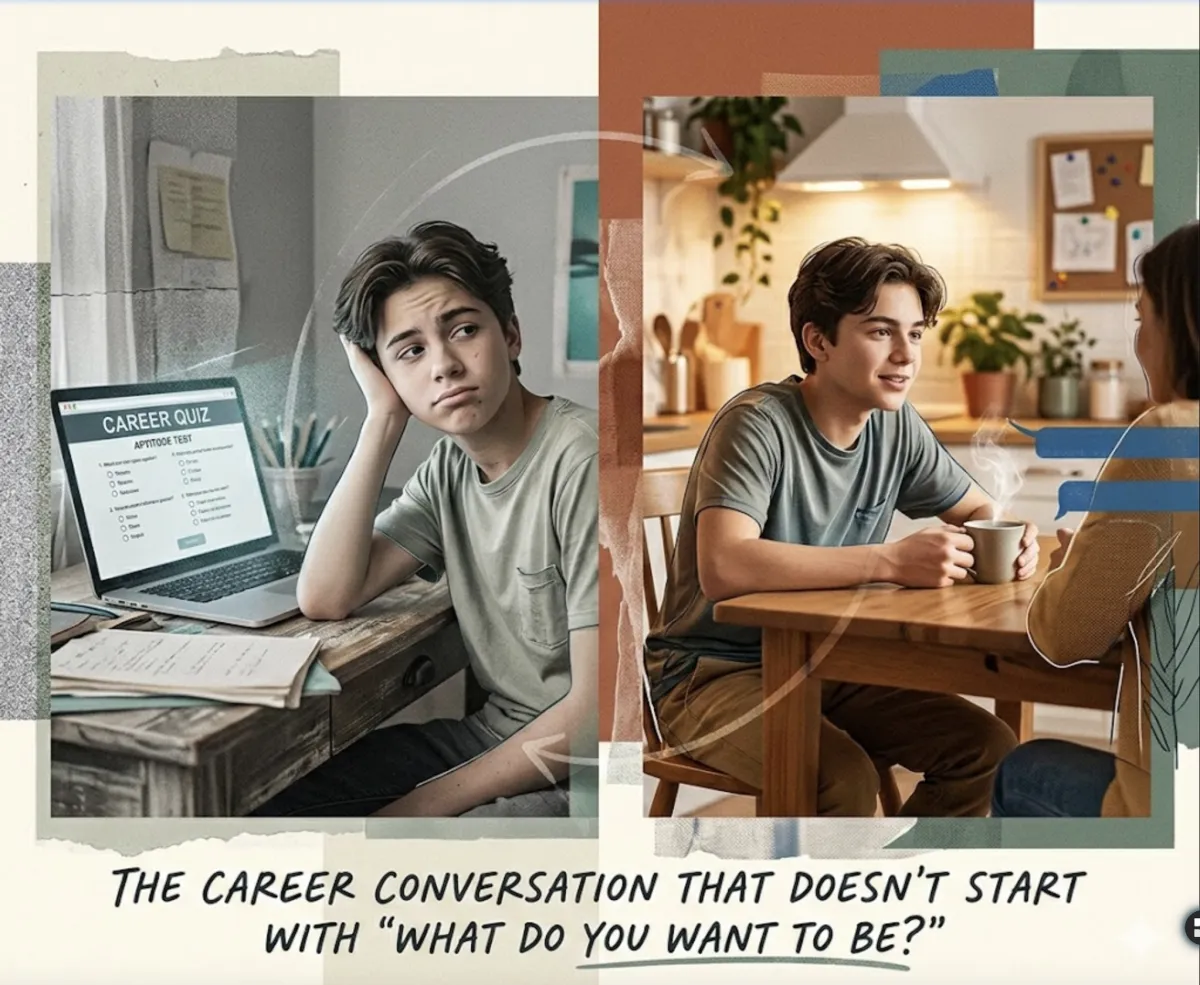
The Career Conversation That Doesn't Start with "What Do You Want to Be?"
"What do you want to be when you grow up?"
Your teen has heard this question approximately four hundred times. From relatives at Thanksgiving, from school counselors in career units, from well-meaning adults who think they're being helpful.
And most teens answer one of three ways: a shrug, a generic safe answer they don't actually mean ("a doctor, maybe?"), or total shutdown.
Here's the thing — the question isn't wrong because it's too big. It's wrong because it demands a conclusion before any research has happened. It asks a teenager to name a destination without ever having seen the map.
Imagine walking into your English class on the first day and the teacher says: "Write your final thesis statement. No, you can't read anything first." That's what "What do you want to be?" sounds like to a teen who hasn't had enough experiences to form an answer.
The academic term for what we're asking them to do is draw a conclusion without evidence. Their ELA teacher would mark that as an incomplete argument. And yet adults do it to teens constantly — then wonder why they shut down.
There's a better way into this conversation. It doesn't start with the answer. It starts with curiosity.
The Standard They're Already Being Graded On
Here's what most parents don't realize: career exploration isn't just a life skill — it's embedded in academic standards your teen is already being assessed on.
The Common Core speaking and listening standards ask students to prepare for and participate in conversations with diverse partners, building on others' ideas. The writing standards ask them to conduct short research projects using multiple sources. The ASCA Mindsets & Behaviors standards explicitly require students to use self-assessment strategies to explore career interests and develop a career plan.
What does that look like in real life? It looks like asking questions, gathering information from multiple sources, and building an understanding of something you didn't know before.
In school, we call that research. In life, we call it figuring out what you want to do.
The skill is identical. The application is the one that actually matters.
Why the Traditional Question Fails (Especially for Some Brains)
"What do you want to be?" assumes your teen has enough data to answer. Most don't. They've seen the inside of a school, their home, and maybe a part-time job. Their career data set is tiny, and we're asking them to make predictions from it.
But there's a deeper problem. The question implies there's one right answer — one destination, one career, one identity they need to lock in now. For teens who already struggle with all-or-nothing thinking, perfectionism, or demand avoidance, this framing is paralyzing.
Some teens freeze because the stakes feel impossibly high. If they pick wrong, they've failed before starting. Others disengage because the question feels abstract and disconnected from anything real — and for a brain that runs on interest and relevance, abstract plus high-pressure equals shutdown. The question doesn't give them anything to grab onto. There's no concrete scenario, no tangible problem, no interesting person — just a blank field and the expectation that they'll fill it with certainty they don't have.
Still others give the "safe" answer because it stops the conversation. "A doctor" ends the interrogation faster than "I have no idea" does, even though "I have no idea" is a more honest and perfectly valid starting point.
And here's the part that gets overlooked: the adults asking the question usually can't answer it well for themselves. Most adults didn't end up where they planned. Most career paths involve pivots, surprises, and opportunities that didn't exist when they were seventeen. We're asking teens to do something we couldn't do — and then treating their uncertainty as a problem.
The fix isn't a better answer. It's a better question.
Five Questions That Actually Open the Conversation
Instead of asking your teen to name a career, try asking questions that build the data set they're missing. These aren't interview questions — they're conversation starters that work over dinner, in the car, or during a walk. No pressure, no agenda.
1. "What do you do that makes time disappear?"
This isn't "what do you like." Teens can rarely articulate what they like in career-useful terms. But they can usually identify the activities where they lose track of time. Gaming, drawing, organizing a playlist, arguing a point, building something, taking care of animals, solving puzzles, editing videos. The activity isn't the career — it's the clue to the kind of thinking that energizes them.
A teen who loses time while editing videos might not want to be a filmmaker. But they might thrive in any role that involves visual storytelling, sequencing, or creative problem-solving. The specifics come later. The signal comes now.
Academic parallel: This is essentially self-assessment — the same skill the ASCA standards ask counselors to teach. Your teen is identifying their learning preferences and intrinsic motivators.
2. "What bothers you that other people seem to ignore?"
Every problem a person notices that others walk past is a signal. The teen who's irritated by bad design is seeing something. The one frustrated by unfairness is seeing something. The one who can't stop pointing out logical inconsistencies is seeing something.
Academic parallel: Identifying problems is the first step in the research process and in every project-based learning framework. The standard doesn't start with the answer — it starts with the question worth asking.
3. "Who do you know whose job you're actually curious about?"
Not "whose job do you want?" — that's the same trap in different clothes. Curious about. That's a lower bar and a more honest one. If they name someone, that's a natural opening for an informational interview — a 15-minute conversation with someone who does a job your teen finds interesting. No application, no commitment, just questions and information.
4. "What's something you're good at that school doesn't give you credit for?"
This question does two things. It validates skills that exist outside the transcript — social intelligence, spatial reasoning, mediation, mechanical aptitude, digital fluency, emotional awareness — and it starts mapping those skills to real-world applications.
Academic parallel: This is metacognition — thinking about your own thinking and abilities. It shows up in CASEL's self-awareness competency and in every portfolio-based assessment framework. Your teen is evaluating their own strengths using evidence from their experience.
5. "If you could shadow anyone for a day — anyone — who would it be?"
This one works even when the other four don't, because it's hypothetical and low-stakes. They don't have to commit to anything. They don't have to know what the person actually does all day. The answer reveals interest, and interest is all you need to start.
What to Do With Their Answers (That Isn't Pressure)
Here's where parents usually make the mistake. Your teen says "I like gaming" and you immediately jump to "game design is very competitive" or "you could do computer science." The conclusion-jump is exactly what shut them down in the first place.
Instead, try what their English teacher would do with a first draft: ask a follow-up question.
"What part of gaming? The building? The strategy? The community? The competition?"
You're helping them narrow without choosing. That's research methodology — moving from broad interest to specific inquiry — and it's a skill they'll use in every college essay, job interview, and career pivot for the rest of their life.
A few scripts for the follow-up:
Teen says: "I don't know, I just like it." You try: "That's fine. What would make you NOT like it? If they changed one thing about it, what would ruin it for you?" (This reversal often gets more useful information than the direct question.)
Teen says: "I want to do something with animals." You try: "Cool — what part? The medical stuff? Being outside? The one-on-one care? There are probably ten different jobs in that space and they look really different from each other."
Teen says: "I have no idea." You try: "That's actually a solid place to start. You don't need an answer. You need information. What if we found one person whose job sounds interesting and you asked them five questions about it?"
That last response matters. "I don't know" isn't a failure. It's an accurate self-assessment from someone without enough data — and the informational interview approach is the most efficient way to start gathering it.
The Skills This Conversation Actually Builds
When your teen engages with these questions — even reluctantly, even with shrugs at first — they're practicing skills that show up in standards and in life:
Self-assessment and reflection. Identifying what energizes them, what frustrates them, where their strengths are. This is CASEL's self-awareness competency and the foundation of every career readiness framework.
Research through conversation. Gathering information from a primary source (a person) rather than a secondary one (a website). This maps to speaking and listening standards that require students to build understanding through dialogue.
Narrowing a broad topic to a specific inquiry. The same skill that turns "I want to write about the ocean" into a focused research question also turns "I like animals" into "I'm curious about wildlife rehabilitation."
Tolerating ambiguity. Sitting with "I don't know yet" instead of grabbing the first answer that stops the discomfort. This is executive function, emotional regulation, and intellectual maturity — and it's the skill most career quizzes accidentally undermine by offering a neat result.
Your teen doesn't need a five-year plan. They need permission to explore without a destination — and a handful of better questions to explore with.
One Thing You Can Try This Week
Pick one of the five questions above. Don't make it formal. Don't announce "we're having a career conversation." Just drop it into an existing moment — dinner, a car ride, a walk.
If they engage, follow up. If they shrug, let it sit. Some of the best answers come three days later, unprompted, when the question has been quietly processing. That's not avoidance — that's how some brains work. The question went in. It's doing something. Give it room.
And if the conversation leads somewhere — if they name a person they're curious about, or a problem that bugs them, or a skill they wish counted — you have a next step. The informational interview turns curiosity into information. The "Just Get a Job" post walks through what happens when they're ready to act on what they've learned. And the Life Skills Progress Tracker helps you see where career readiness fits into the bigger picture of what your teen is building — for free.
Your teen doesn't need to know what they want to be. They need someone willing to ask better questions and wait for the answer.
STANDARDS ALIGNMENT
CCSS ELA — Speaking & Listening
CCSS.ELA-LITERACY.SL.9-10.1: Initiate and participate effectively in a range of collaborative discussions with diverse partners, building on others' ideas and expressing their own clearly and persuasively.
CCSS.ELA-LITERACY.SL.11-12.1.C: Propel conversations by posing and responding to questions that probe reasoning and evidence.
CCSS ELA — Writing (Research)
CCSS.ELA-LITERACY.W.9-10.7: Conduct short as well as more sustained research projects to answer a question or solve a problem; narrow or broaden the inquiry when appropriate.
ASCA Mindsets & Behaviors
M 4: Understanding that postsecondary education and lifelong learning are necessary for long-term career success.
B-LS 7: Identify long- and short-term academic, career, and social/emotional goals.
B-SMS 5: Demonstrate perseverance to achieve long- and short-term goals.
CASEL Competencies
Self-Awareness: The ability to accurately recognize one's own emotions, thoughts, and values and how they influence behavior.
Responsible Decision-Making: The ability to make caring and constructive choices about personal behavior and social interactions across diverse situations.
ISTE Standards
1.1 Empowered Learner: Students leverage technology to take an active role in choosing, achieving, and demonstrating competency in their learning goals, informed by the learning sciences.
