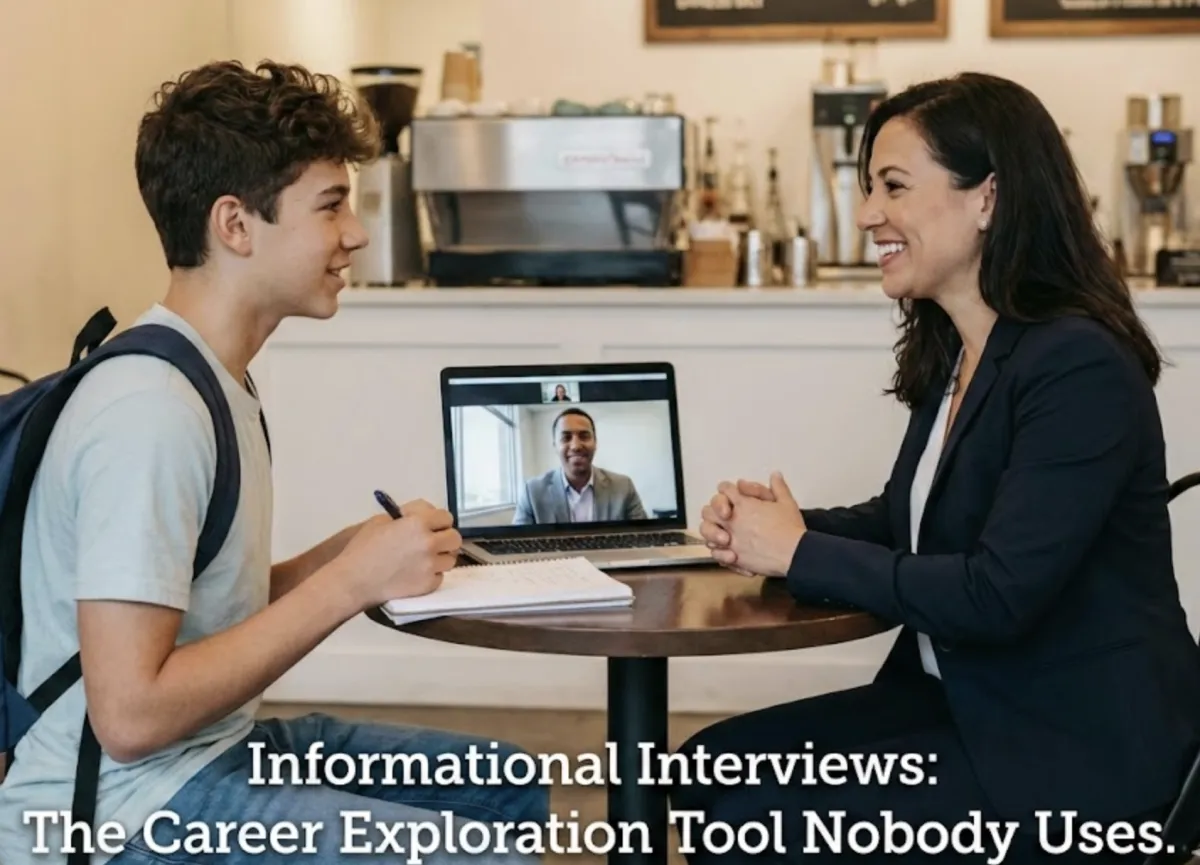
Informational Interviews: Career Exploration for Teens
"What do you want to do after high school?"
It's the question adults love to ask and teens dread answering. Because how are you supposed to know what you want to do when you've never actually done any of it?
Career exploration usually means taking an online quiz, reading job descriptions, or maybe shadowing someone for a day. These are fine, but they're limited. Quizzes tell you about yourself, not about actual jobs. Job descriptions are sanitized marketing. Shadowing shows you one day in one role at one company.
There's a better tool. It's free, it's available to anyone, and almost no one uses it.
Informational interviews.
What's an Informational Interview?
An informational interview is a conversation with someone who does a job you're curious about. Not a job interview—you're not asking them to hire you. You're asking them to tell you what their work is actually like.
That's it. You reach out, ask if they'd be willing to chat about their career, and have a conversation.
The purpose isn't to get a job. It's to get information. Real, unfiltered information about what a career path actually involves—from someone living it.
What your teen is practicing, without realizing it, is one of the most academically rigorous skills there is: research through primary sources. Every English class asks students to go beyond surface-level sources and seek out firsthand evidence. An informational interview is that—applied to their own future. The person sitting across from them (or on the other end of the video call) is a primary source no search engine can replicate.
Why It Works Better Than Research
Job descriptions tell you what employers want you to know. People in the actual jobs will tell you the rest.
What's the day-to-day really like? What do you wish you'd known before starting? What's frustrating about this work? What kind of person thrives here versus struggles? How did you get into this field? What would you do differently?
You can't Google these answers. You have to ask someone.
There's a communication standard woven through every grade level: the ability to gather information through purposeful conversation, ask relevant follow-up questions, and synthesize what you hear into usable knowledge. Informational interviews are that standard in action—except the "assignment" is figuring out your own future.
Some teens absorb this kind of information far better through conversation than through reading. If your teen tends to tune out job description paragraphs but lights up when talking to real people about real things, informational interviews aren't a workaround—they're actually the more rigorous research method.
Why Almost No One Does This
It feels awkward. Reaching out to someone you don't know, asking for their time, not even having a job on the line to justify it—this is uncomfortable for most adults, let alone teens.
But here's what I've learned working in workforce development: people love talking about their work to someone genuinely interested. The request itself is flattering. Most people say yes.
The discomfort is front-loaded. Five minutes of awkwardness sending the request leads to a conversation that could save years of pursuing the wrong path.
Finding People to Interview
This is where teens get stuck. "I don't know anyone who does what I'm interested in."
They might not know them directly. But they know people who know people. And there are ways to find professionals even when starting from zero.
Start with the existing network.
Parents, relatives, family friends, neighbors, parents of friends, teachers, coaches—tell them what you're exploring and ask if they know anyone in that field.
"I'm researching careers in physical therapy. Do you happen to know anyone who works in that area who might be willing to talk to me?"
Adults know a lot of people. They just don't think to connect unless asked.
Use LinkedIn.
LinkedIn isn't just for job searching—it's a directory of professionals organized by what they do. Your teen can search for job titles they're curious about, filter by location if they want someone nearby, and send connection requests with a note explaining why they're reaching out. Many professionals are genuinely open to helping students exploring careers.
Ask at school.
Guidance counselors sometimes have connections or know about career exploration programs. Teachers may have worked in industry before teaching, or know former students in various fields. Alumni networks are particularly useful—graduates from your teen's own school are often especially willing to help.
Professional associations.
Many fields have professional organizations, some of which have mentorship programs or explicitly welcome student inquiries. A quick search for "[field] professional association" often surfaces options.
Local businesses.
Sometimes the simplest approach works best. A physical therapy clinic. An architecture firm. A marketing agency. Small and mid-sized businesses are often far more accessible than large corporations.
How to Ask
Keep the request short, specific, and respectful of their time.
What to include: who you are, why you're reaching out, what you're asking for (15-20 minutes), how you found them, and flexibility about format and timing.
Sample message:
Subject: Student Interested in Learning About [Field]
Hi [Name],
My name is [Your Name], and I'm a junior in high school exploring potential career paths. I'm really interested in learning more about [field/role], and I came across your profile on LinkedIn [or: my neighbor mentioned you work in this area].
Would you be willing to spend 15-20 minutes talking with me about your work? I'd love to hear what your day-to-day is like and any advice you have for someone considering this field.
I'm happy to meet whenever is convenient for you—phone, video call, or in person all work for me.
Thank you so much for considering this.
[Your Name]
What if they don't respond?
Some people won't, and that's okay. It's not personal—people are busy, emails get lost, life happens. Wait about a week and send one polite follow-up. If you still don't hear back, move on. There are other people to ask. Don't let a few non-responses stop you from reaching out to others.
What to Ask During the Interview
Come prepared with questions. Write them down. You don't have to follow them rigidly, but having a list keeps the conversation productive and shows you respect their time.
Questions about their path:
How did you get into this field?
What was your educational path? Was it necessary, or are there other routes in?
What did you do early in your career that helped you get where you are?
Is there anything you'd do differently if you were starting over?
Questions about the work:
What does a typical day or week look like for you?
What do you enjoy most about your job?
What's challenging or frustrating about it?
What skills do you use most often?
What surprised you about this work once you started doing it?
Questions about the field:
What's the job market like right now?
Are there areas of growth or decline worth knowing about?
What misconceptions do people have about this career?
What kind of person tends to thrive here? Who tends to struggle?
Questions for you specifically:
What advice would you give someone my age who's interested in this field?
Is there anything I could be doing now to explore further?
Are there other people you'd recommend I talk to?
That last question matters. One conversation often leads to another.
Let the conversation flow.
The questions are a starting point, not a script. If they mention something interesting, follow up on it. The best information often comes from tangents. Leave space for them to share what they think is important, not just what you thought to ask.
During the Interview: Etiquette Matters
Be on time. For a call or video chat, be ready a few minutes early. Being late to something you requested is disrespectful.
Be present. Put the phone away. Take notes if it helps you remember, but stay engaged. Make eye contact on video calls.
Keep to the time you asked for. You requested 15-20 minutes—stick to that unless they clearly want to keep going. Ending on time shows respect. If the conversation is flowing and they seem happy to continue, you might ask: "I know I said 15 minutes—do you have a bit more time, or should we wrap up?"
Be genuine, not performative. You're not interviewing for a job. Genuine curiosity is more engaging than trying to seem impressive. Ask what you actually want to know. Admit when you don't understand something.
After the Interview
Send a thank-you note. Within 24 hours, send a brief email thanking them for their time. Mention something specific from the conversation that was helpful or interesting. This is relationship maintenance—you might want to reach out again someday.
Actually use what you learned. Take a few minutes to write down key takeaways while they're fresh. Did this path become more or less interesting? What questions do you still have?
Follow up if they suggested it. If they offered to connect you with someone else, follow through. If they said "let me know how it goes," actually let them know later. These small follow-throughs build real professional relationships. The people your teen informational-interviews now might become references, mentors, or connections years from now.
Why This Matters More for Some Teens
If your teen doesn't have a lot of adults in their life with varied professional backgrounds—if your family works in a few fields and obvious connections aren't readily available elsewhere—informational interviews level the playing field.
They give access to knowledge and networks that other students might get automatically through family connections. That's not a small thing.
And for teens who learn better through conversation than reading, who need real examples rather than abstract descriptions, who want to understand what a job actually feels like rather than what it looks like on paper—this approach fits the way their brain works. It's not a workaround for students who struggle with traditional research. It's a legitimate, rigorous method that happens to align with how many people learn best.
This is experiential learning about careers. It's concrete, it's personal, and it sticks in a way that career websites don't.
→ Related: Interest-Based Nervous System: Teaching When Traditional Methods Fail
For Parents: How to Support This
Help them brainstorm who to ask. You know more people than they do. Think through your network—who works in fields they're curious about? Who might know someone who does?
A warm introduction goes a long way: "My daughter is exploring careers in X and would love to learn about your work—would you be open to a short conversation with her?"
Help with the outreach, don't do it for them. They can write the email and make the ask—but they might need help figuring out what to say, or encouragement that it's okay to reach out to someone they don't know. Offer to review their message before they send it. Talk through what they'll ask. Let them be the one who actually does it.
Debrief afterward. Ask what they learned. What surprised them? Did it make them more or less interested in the field? What else do they want to explore? These conversations help them process the information and figure out what it means for their own path.
Model this yourself. Have you done informational interviews in your own career? Talk about it. Let them see that this is a normal thing adults do when exploring opportunities—not a weird exercise for students.
The Bottom Line
Career exploration doesn't have to mean quizzes and guesswork. Real information about real careers exists—in the heads of people doing those jobs.
Informational interviews give access to that information. They cost nothing but a bit of courage to ask and some time to listen.
Most people will say yes. The conversation is almost always valuable. And you come away knowing something you couldn't have learned any other way.
Your teen doesn't have to know what they want to do with their life. But they can start gathering information to figure it out.
Ask someone about their job. See what you learn.
Looking for a way to track which life skills your teen is building as they explore careers? The Life Skills Progress Tracker is a free resource to help you see the whole picture.
If you're supporting a teen who thrives with real-world communication skills, the Real-World Communication Skills Bundle includes tools for building exactly the kind of purposeful conversation and self-advocacy skills informational interviews require.
