Industrial Revolution Life Skills for Teens | Life Prep Curriculum
The Hustle Isn’t New
Your teen wants to be an entrepreneur. Or a content creator. Or “something with technology.” They talk about passive income and side hustles like they invented the concept.
They didn’t. Someone in a Manchester factory in 1790 beat them to it by about 250 years.
The playbook for everything your teen is excited about — innovation, disruption, scaling, getting paid for ideas instead of hours — was written during the Industrial Revolution. And it’s sitting in the history curriculum they’re currently zoning out on.
Here’s the thing: when teens hear “Industrial Revolution,” they picture steam engines and child labor. What they don’t picture is the moment that created everything they take for granted — paychecks, banks, consumer credit, career ladders, the entire concept of a “job” as something separate from where you live.
That disconnect isn’t their fault. It’s a framing problem. And it’s one that, once you see it, makes this unit one of the most relevant things in their entire course load.
The Economic Vocabulary Your Teen Already Needs
World History standards covering the Industrial Revolution ask students to analyze economic transformation, technological innovation, labor systems, and the relationship between production and wealth. Those aren’t dusty abstractions. Those are the operating instructions for the economy your teen is about to enter.
Think about what happened between 1760 and 1840. People went from making things by hand in their homes to working in factories on someone else’s schedule for someone else’s profit. That shift created the modern paycheck. It created the distinction between “your time” and “work time.” It created wage negotiation, because suddenly your labor had a market price.
Your teen who’s about to apply for their first summer job? They’re stepping into a system that was architected during this exact historical period. Knowing where the system came from gives them leverage inside it. (The Life Skills 101 Guide maps how these economic foundations connect to every other skill your teen needs.)
Then and Now: The Parallels They’re Not Seeing
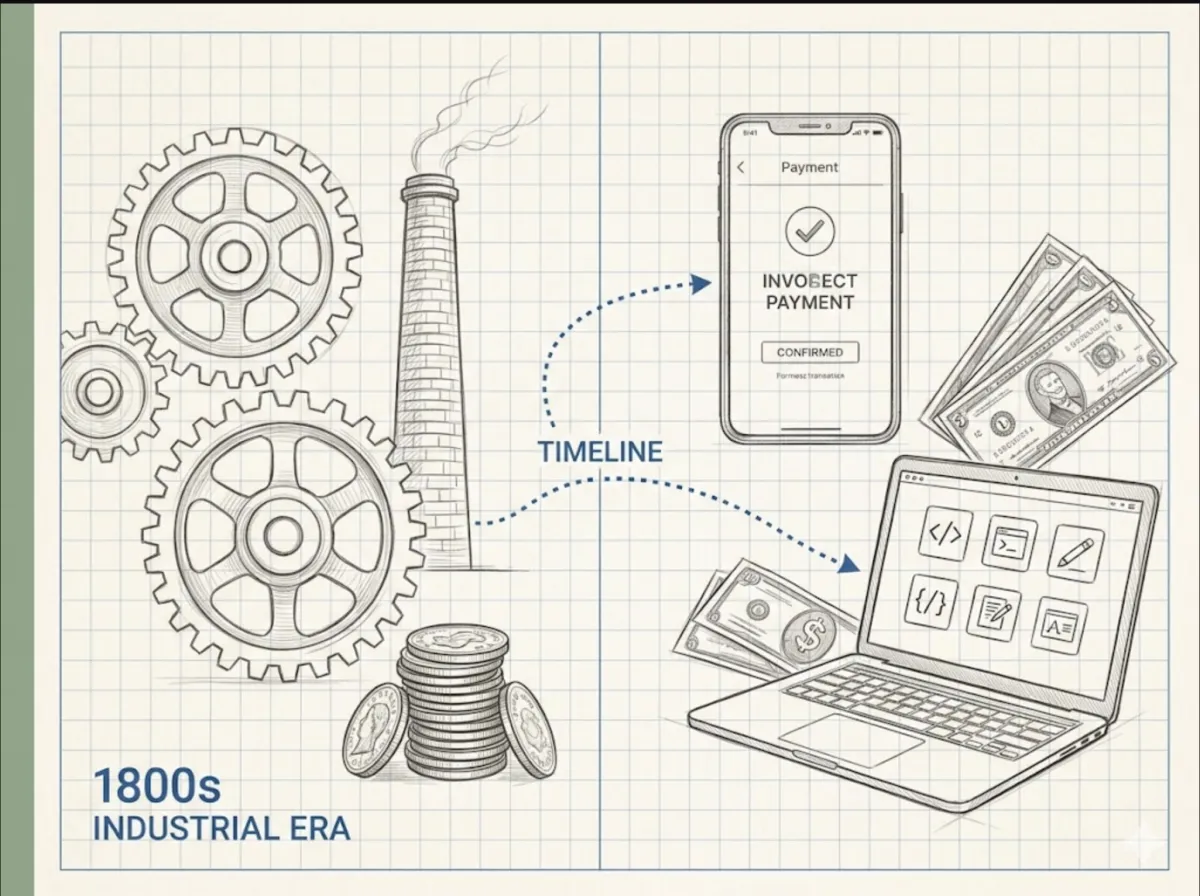
Every row in that comparison is a connection point between what the standard asks them to learn and what they’re going to live through.
The Translation Your Teen Needs to Hear
When your teen asks “Why do I need to know about factories?” they’re actually asking a fair question. The answer isn’t “because it’s on the test.” The answer is that factories were the first version of the system they’re about to spend forty years inside.
When teens hear the Industrial Revolution explained as the origin story of the economy they live in, the eye-rolling stops. Not because history suddenly became cool — but because it suddenly became relevant.
For some teens, the connection clicks through the comparison cards — seeing it side-by-side makes the abstract concrete. Others do better with the narrative: tell the story of a 14-year-old factory worker’s day, then ask what’s different about their own. The entry point matters less than the moment where relevance lands. If your teen engages better with specifics than abstractions, lead with the story. If they’re a pattern-spotter, lead with the cards.
Either way, the standard gets taught. The life skill gets built. And nobody had to sit through a lecture about why the spinning jenny matters.
Want this conversation pre-built with primary sources, wage calculations, and a full debate activity? The Industrial Revolution Unit Pack (WH-IND-001) launches later this month. Watch for it. In the meantime, the Life Skills 101 Guide is a free starting point for connecting any standard to the skill it’s secretly teaching.
Standards Alignment
CCSS.ELA-LITERACY.RI.9-10.6: Determine an author’s point of view or purpose in a text and analyze how an author uses rhetoric to advance that point of view or purpose.
CCSS.ELA-LITERACY.RI.9-10.9: Analyze seminal U.S. and world documents of historical and literary significance for their themes, purposes, and rhetorical features.
D2.Eco.1.9-12 (C3 Framework): Analyze how incentives influence choices that may result in policies with a range of costs and benefits for different groups.
D2.Eco.6.9-12 (C3 Framework): Generate possible explanations for a government role in markets when market inefficiencies exist.
D2.His.1.9-12 (C3 Framework): Evaluate how historical events and developments were shaped by unique circumstances of time and place as well as broader historical contexts.
WH.13(A) (TEKS): Identify the causes and impact of the Industrial Revolution on political, economic, and social developments.
WH.13(B) (TEKS): Explain how industrialization led to changes in the standard of living and the labor force.
CASEL — Responsible Decision-Making: The ability to make caring and constructive choices about personal behavior and social interactions across diverse situations.
CASEL — Self-Awareness: Recognizing one’s strengths, limitations, and values.
ASCA B-LS 7: Identify long- and short-term academic, career, and social/emotional goals.
ASCA M 4: Understanding that postsecondary education and lifelong learning are necessary for long-term career success.
