Your Teen’s Body Is Keeping Score (Even If Grades Look Fine)
Your teen made honor roll in January. They seemed fine in February—maybe a little tired, maybe a little shorter with you, but fine. Now it’s March, and something has shifted.
The homework battles are worse. The mornings are harder. They’re sleeping more or barely sleeping at all. They snapped at you over breakfast for asking if they wanted eggs.
Nothing happened. There’s no crisis, no breakup, no bad grade triggering this. So what changed?
Nothing changed. Everything accumulated.
The Biology Your Teen Is Living (But Not Connecting)
Here’s what’s actually happening inside your teen’s body right now—and this is biology they’re already being tested on, even if nobody’s shown them the mirror.
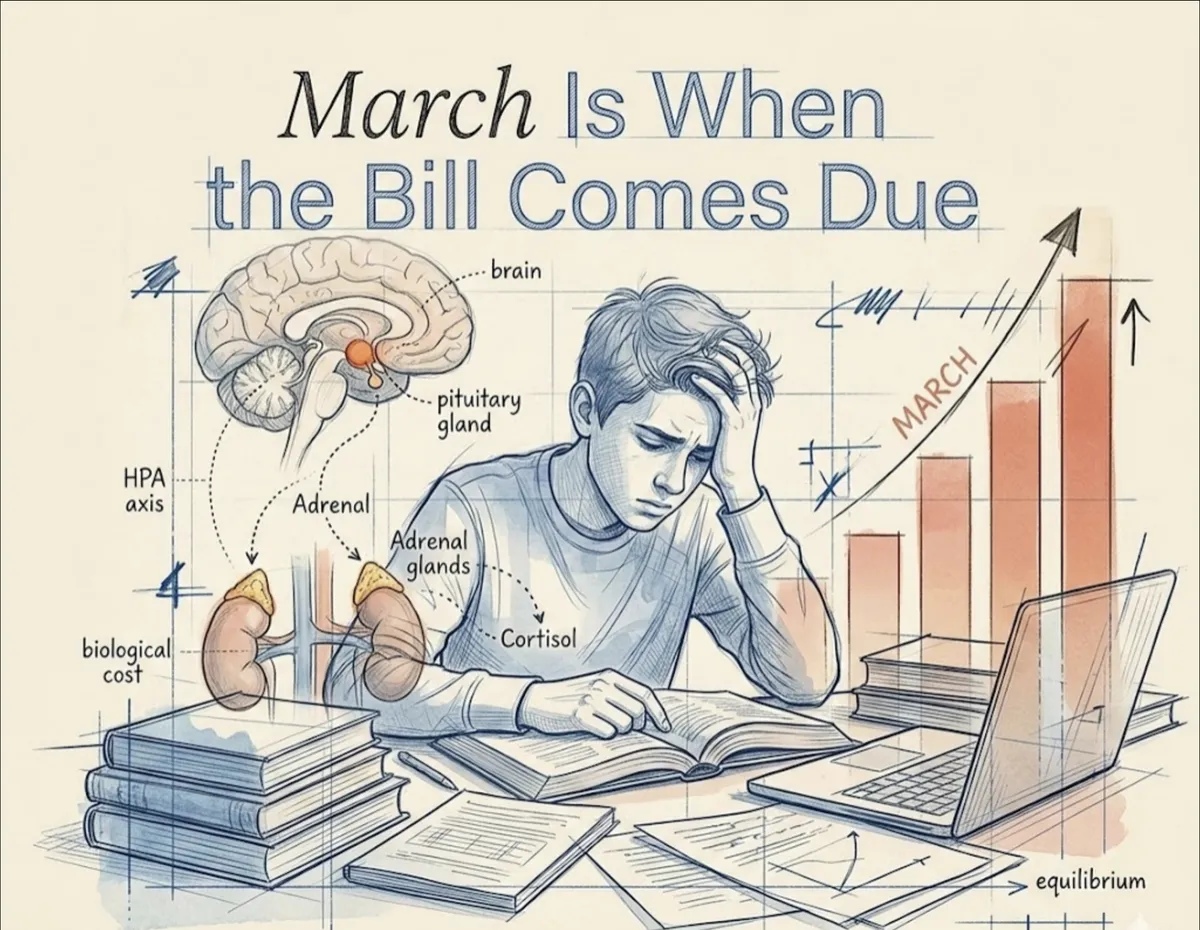
When your teen encounters stress—a test, a social conflict, a parent asking about grades—their hypothalamic-pituitary-adrenal axis (HPA axis) activates. The hypothalamus signals the pituitary gland, which tells the adrenal glands to release cortisol. This is the stress response they can diagram on a biology exam. Fight, flight, or freeze. Adrenaline, cortisol, elevated heart rate.
The system is designed to spike and recover. Stressor appears, body responds, stressor passes, cortisol returns to baseline. Your teen’s biology textbook presents this as a clean cycle with arrows.
But the textbook version assumes the stressor goes away.
Allostatic Load: The Concept That Explains March
There’s a term in stress physiology that your teen probably hasn’t encountered yet, even though they’re living it: allostatic load.
Allostasis is the body’s process of maintaining stability through change—adapting to stressors by adjusting hormone levels, immune function, metabolism, and cardiovascular output. Every time the stress response activates, the body pays a biological cost to return to equilibrium.
Allostatic load is the cumulative cost of all that adapting.
Think of it like a credit card balance. Each stressor is a charge. A quiz on Tuesday, a social media conflict on Wednesday, a fight with a sibling on Thursday, a college-readiness assembly on Friday. Individually, each one is manageable. The body activates, responds, recovers.
But if the charges come faster than the payments, the balance grows. And by March—after six months of academic demands, social navigation, hormonal shifts, sleep disruption, and the ambient pressure of existing as a teenager in a world that feels like it’s on fire—the balance is very, very high.
The body doesn’t keep score with grades. It keeps score with cortisol.
What High Allostatic Load Actually Looks Like in a Teen
This is where parents get confused, because high allostatic load doesn’t always look like “stressed.” It often looks like things adults interpret as character problems.
Chronic elevated cortisol suppresses the prefrontal cortex—the part of the brain responsible for planning, impulse control, and emotional regulation. At the same time, it hyperactivates the amygdala, the brain’s threat detection center. The result is a brain that’s simultaneously less able to think clearly and more reactive to everything.
So the teen who “overreacted” to being asked about eggs? Their amygdala interpreted a neutral question as one more demand on a system already running on fumes. The teen who “can’t get off the couch”? Their prefrontal cortex is suppressed by the same cortisol that’s been accumulating since September.
What it looks like from outside: lazy, dramatic, moody, unmotivated, defiant.
What it looks like from inside: exhausted, overwhelmed, unable to access their own executive function, and deeply confused about why everything feels so hard when “nothing happened.”
Your teen’s biology class teaches homeostasis as the body’s tendency to maintain a stable internal environment. What they don’t usually cover is what happens when the body has been maintaining that stability at maximum effort for months. The system doesn’t crash dramatically. It degrades gradually. March is often when the degradation becomes visible.
Why March Specifically
This isn’t random timing. March sits at the convergence of multiple stressor cycles.
Third-quarter grades are due. Standardized testing season is starting or imminent. Daylight saving time disrupts circadian rhythm—and teen circadian rhythms are already shifted later than adults’, making the transition harder. Winter’s reduced sunlight has depleted vitamin D and serotonin over months. Social dynamics have been simmering since September and often reach their peak complexity in spring.
For college-bound juniors, add SAT/ACT prep pressure, campus visit planning, and the ambient anxiety of a process they can’t control. For seniors, add decision fatigue, senioritis shame, and the looming reality that everything is about to change.
None of these is catastrophic alone. Together, they’re a cumulative biological event.
The health education standard your teen’s school covers—“analyze how environment and personal health are connected”—is exactly this. They’re just not being asked to apply it to their own body’s March collapse.
What Makes It Worse (The Stuff Parents Do with Good Intentions)
When you see your teen struggling, your instincts are good: fix it, help them, push them through. But some of the most common responses to a stressed teen actually increase allostatic load rather than reducing it.
Adding urgency to the urgency.
“You need to get it together—third quarter counts.” Your teen already knows. The information isn’t missing; the capacity to act on it is. Adding urgency to a system already in overdrive doesn’t create motivation. It adds another cortisol spike to an account that’s already overdrawn.
Removing rest as a consequence.
Taking away downtime because they “didn’t earn it” removes the only tool their nervous system has for reducing cortisol. Rest isn’t a reward. Biologically, it’s a recovery mechanism. Removing it is like taking away someone’s inhaler because they didn’t run fast enough.
Interpreting shutdown as apathy.
A disengaged teen often isn’t checked out—they’re in freeze mode. The dorsal vagal response, part of the polyvagal system, causes the body to conserve energy by shutting down. It’s not a choice. It’s the nervous system’s last resort when fight and flight have failed.
Demanding verbal processing when they can’t access it.
“Talk to me. What’s wrong?” When the prefrontal cortex is suppressed, verbal articulation is one of the first skills to go offline. Asking a stressed teen to explain what they’re feeling is asking them to use the exact brain region that cortisol has temporarily taken offline.
What Actually Helps (Based on How the Stress System Works)
If the problem is biological, the first responses need to be biological too. Not behavioral. Not motivational. Physiological.
Reduce sensory and demand load first.
Before you try to solve anything, lower the total input. Fewer questions. Fewer transitions. Fewer decisions. The nervous system needs space to downregulate before the prefrontal cortex comes back online. You might try giving them 20 minutes of zero-demand time when they get home before any conversation about school.
Prioritize sleep above everything else.
Cortisol regulation depends on sleep. Teen circadian biology requires 8–10 hours, with natural sleep onset around 11 PM. If your teen is sleep-deprived—and most are—no strategy, supplement, or conversation will outperform letting them sleep. This might mean temporarily deprioritizing a homework assignment. That feels wrong. The biology says it’s right.
Move the body to reset the stress cycle.
Physical movement completes the stress response cycle. The body activated for fight or flight but never actually ran or fought—it just sat in a classroom chair. A walk, a bike ride, shooting hoops, even aggressive vacuuming—any movement that lets the body discharge the energy the stress response mobilized. This isn’t exercise as punishment or productivity. It’s giving the nervous system what it was biologically preparing for.
Co-regulate before you communicate.
Your nervous system talks to your teen’s nervous system before any words get processed. If you’re activated—frustrated, anxious about their grades, performing urgency—their system mirrors yours and escalates. Calming your own body first (slow breathing, lower vocal pitch, relaxed posture) gives their system something safe to mirror. This is the polyvagal concept of co-regulation, and it’s one of the most evidence-supported interventions in stress physiology.
Name it without fixing it.
“You look wiped. March is heavy.” That’s it. You don’t have to solve it. You don’t have to process it. Acknowledging the load—without attaching a lesson, a plan, or a consequence—gives the teen’s nervous system the signal that the environment is safe. Safe enough, maybe, for the prefrontal cortex to start coming back online.
The Standards to Life™ Connection
Everything in this article—the HPA axis, allostatic load, cortisol regulation, the prefrontal cortex, the polyvagal system—is content your teen is already encountering in biology, health, and psychology classes. They can label the parts. They can trace the pathways. They might even ace the test.
What they can’t do, usually, is apply it to themselves.
That’s the gap the Standards to Life™ Framework exists to close. The standard says “analyze the relationship between stress and homeostasis.” The life skill is recognizing that their own irritability, exhaustion, and shutdown are homeostasis breaking down. The standard says “describe how the body maintains internal balance.” The life skill is understanding that their body has been maintaining balance at maximum cost for six months and March is when the bill comes due.
When academic content becomes a mirror instead of a textbook, teens don’t just learn the material. They learn themselves.
What to Do This Week
Tonight, try this: instead of asking about homework, say “You look like your system is running pretty hard right now. What would help it settle?”
They might not know. That’s fine. The question itself communicates something important: you see the load, and you’re not adding to it.
March is hard. Not because your teen is failing. Because their body has been keeping score all year, and the total is coming due. The grades might look fine. The body tells a different story.
Your job right now isn’t to fix the stress. It’s to stop adding to the pile and start making space for recovery. The biology says that’s enough to change the trajectory.
Want a framework for this? The PAUSE Method: Digital Wellness & Stress Management teaches teens to identify their stress triggers, track their body’s response, and build a personalized strategy that actually fits their life. It ties directly to the biology standards they’re already being graded on. 30 minutes. Real science. Real skills.
Not sure where your teen’s stress is showing up? Start with the free Life Skills Progress Tracker to see the full picture—executive function, communication, self-management, and more.
Related reading: Your Teen Isn’t Lazy, Broken, or Defiant: A Parent’s Guide to What’s Actually Going On
