Your Teen Isn’t Lazy, Broken, or Defiant: A Parent’s Guide
It’s 9:47 PM. The project is due tomorrow. Your teen is lying on the couch scrolling TikTok, and the laptop is closed on the kitchen table exactly where you put it three hours ago.
You’ve reminded them. Twice. You’ve offered help. You’ve threatened consequences. Nothing.
So you land on the explanation that feels most available: they’re lazy. Or they don’t care. Or they’re doing this on purpose to push your buttons.
Here’s what I need you to consider: none of those are probably true.
Over the past several months, I’ve written a series of articles exploring why teens get stuck, shut down, melt down, or refuse—and what the actual science says is happening underneath. Every single piece comes back to the same core truth: the behavior you’re seeing on the surface almost never matches the experience happening inside your teen’s brain.
This is your starting point. If you’ve been Googling some version of “why can’t my teen do anything” at 11 PM, this guide organizes everything into a reading path that builds understanding in sequence—not a random list, but a progression from “what’s happening” to “what actually helps.”
Start Here: The Operating System Is Different
Most parenting advice assumes all brains run the same software. Set up a reward, apply a consequence, explain why it matters—motivation handled. But for a significant number of teens, the motivational system itself works differently. Not worse. Differently.
If you’ve ever watched your teen play a video game for six straight hours and then be unable to spend fifteen minutes on homework they actually understand, you’ve seen this in action. It’s not a willpower problem. It’s an operating system difference.
Read first: Interest-Based Nervous System: Teaching When Traditional Methods Fail — This article explains the neuroscience of why importance-based motivation (deadlines, consequences, “you need this for college”) doesn’t activate certain brains the way it does others. It’s the foundation for everything else in this guide. Once you understand that your teen’s brain literally runs on a different fuel source, every other behavior starts making more sense.
The academic concept underneath—executive function, the prefrontal cortex’s role in self-regulation—is already in your teen’s biology curriculum. They’re being tested on the brain regions responsible for planning, prioritizing, and initiating action. They just haven’t been shown that the same science explains why Tuesday’s homework feels physically impossible.
When “Just Do It” Makes Everything Worse
Once you understand the operating system difference, the next piece falls into place: demands themselves can trigger a threat response.
For some teens, being told to do something—even something they want to do, even something fun—activates the same neurological alarm system as actual danger. The demand itself becomes the problem. This isn’t defiance. It’s a nervous system that interprets expectations as threats.
Read next: Teaching Life Skills to Demand-Avoidant Teens: Why “Just Do It” Backfires — This breaks down what demand avoidance actually looks like (hint: it’s often disguised as negotiation, distraction, or sudden physical complaints), why it happens, and how to work with it instead of against it. The strategies here aren’t about lowering expectations. They’re about removing the threat so your teen’s brain can actually engage.
The parallels to what your teen is learning about the autonomic nervous system in health class are direct. Fight, flight, freeze—they can explain these on a test. They just can’t see that their own meltdown over being asked to unload the dishwasher is the freeze response in action.
The Freeze That Looks Like Laziness
This is the article most parents tell me hits hardest, because it reframes the single most frustrating behavior: the teen who is doing nothing.
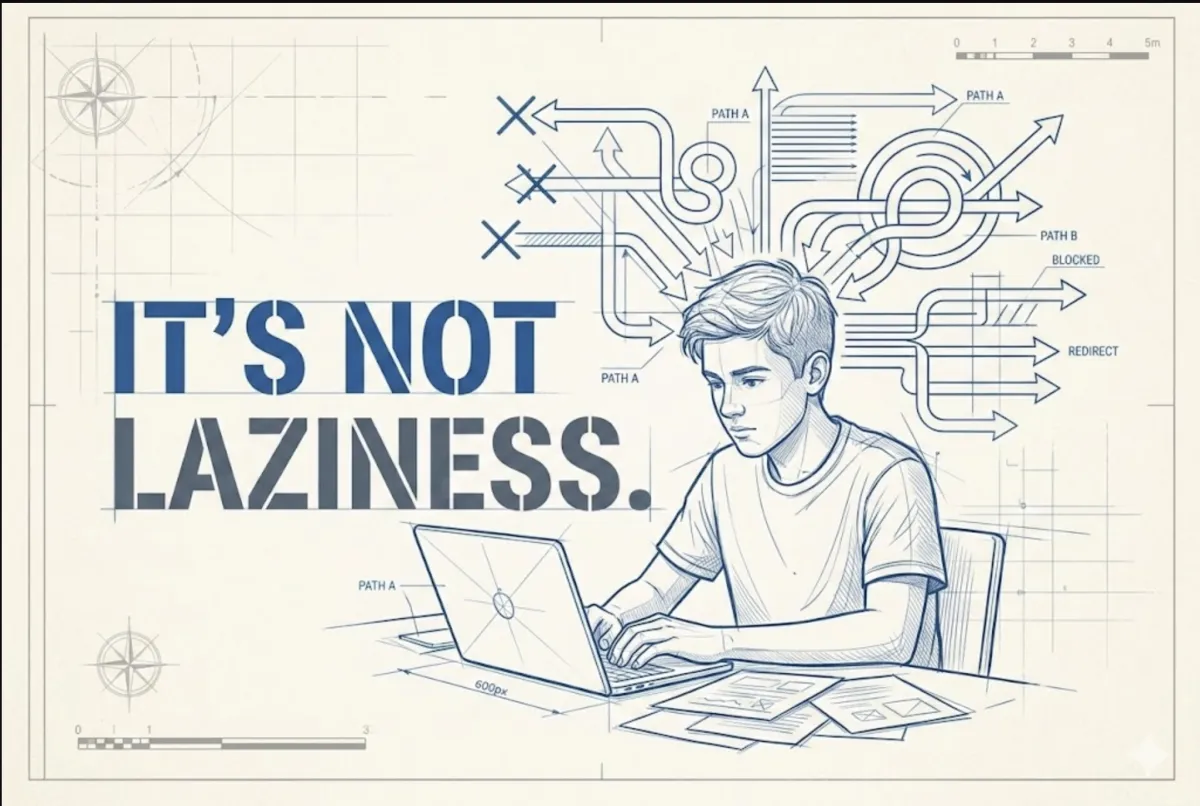
They’re not doing nothing. They’re stuck. Task paralysis is neurological, not moral. The prefrontal cortex—the part of the brain responsible for initiating action—is overwhelmed, overloaded, or underactivated. The result looks identical to laziness from the outside. From the inside, it feels like being trapped behind glass, watching yourself fail in slow motion.
Read next: Task Paralysis Isn’t Laziness: What’s Actually Happening in Your Teen’s Brain — This goes deep into the neuroscience of why starting is the hardest part, what makes it worse (spoiler: reminders don’t contain new information on the fourth attempt), and what actually helps. The “make starting stupidly small” approach alone has changed how dozens of families handle homework time.
Your teen is learning about cognitive load in their psychology or AP classes. The concept that working memory has a limited capacity and can be overwhelmed? That’s not abstract theory. That’s why they’re staring at a blank document unable to type.
Why Everything You’ve Tried Hasn’t Stuck
Here’s where it gets really honest. You’ve probably already tried strategies. Charts, planners, apps, conversations. Maybe they worked for a week. Maybe they never got off the ground.
The problem usually isn’t the strategy. It’s the delivery method. Most life skills curricula—and most parenting advice—teach skills in a way that works for one type of brain and then blames the other types when the approach doesn’t transfer.
Read next: Why Life Skills Lessons Don’t Stick (And What to Do Instead) — This article examines the five frameworks from learning science—cognitive load theory, retrieval practice, transfer learning, self-determination theory, and cognitive apprenticeship—that explain why traditional approaches fail and what research says actually works. If you’ve been frustrated that your teen “knows” a skill but can’t use it when it counts, this is the explanation.
The meta-learning skills your teen is graded on—study strategies, self-assessment, reflection on their own learning process—those are the same executive function skills this article addresses. School calls them “student success behaviors.” We call them life skills. Same thing, different container.
Building the Skill They’ll Need Most
Once you understand what’s happening (operating system difference), what makes it worse (demand triggers, cognitive overload), and why past strategies didn’t stick (delivery mismatch), there’s one more piece: your teen needs to be able to explain all of this themselves.
Not to you. To teachers, coaches, future employers, college advisors, doctors. Self-advocacy—the ability to understand how your own brain works and communicate what you need—is the skill that makes every other skill transferable.
Read next: Teaching Teens Self-Advocacy Skills: The Script They’re Missing — This isn’t about teaching teens to make excuses. It’s about giving them the language to say “I work best when...” instead of shutting down silently. The article includes actual scripts teens can use in classrooms, at appointments, and in conversations with adults who don’t yet understand how their brain works.
Self-advocacy is literally a graded competency in most school counseling frameworks and SEL standards. Your teen’s school already expects them to “identify personal strengths and challenges” and “seek help when needed.” They just haven’t been given the scripts to do it without shame.
The Foundation: Structure That Flexes
Everything in this guide builds from one insight: routines and structure aren’t the enemy of neurodivergent teens. Rigid, one-size-fits-all routines are the enemy. The difference matters.
Read next: Back-to-School Routines That Actually Stick for Neurodivergent Teens — While this was written for the back-to-school season, the framework applies year-round. It covers how to build routines that account for executive function differences instead of ignoring them. If the other articles in this guide helped you understand what’s happening, this one helps you build the container that actually supports it.
The concept of systems design—creating structures that work for the people using them instead of demanding people conform to the structure—runs through your teen’s engineering, technology, and even social studies standards. Universal design isn’t a special accommodation. It’s good design that works for everyone.
Where to Start Tonight
If you’re reading this at 11 PM because today was hard, here’s what I’d suggest:
Read the Interest-Based Nervous System article first. It’s the lens shift that changes everything else. Once you see the operating system difference, you can’t unsee it—and your frustration starts transforming into something more useful: curiosity.
Then, whichever article title made you think “that’s us”—read that one next.
You don’t have to read them all at once. You don’t have to implement anything tonight. Understanding what’s actually happening is the first step. And you just took it.
Your teen isn’t lazy. They’re not broken. They’re not defiant. They’re navigating a world that wasn’t designed for their brain—and they need you on their team, not across from them.
That shift? From opponent to teammate? It changes everything.
Want to see where your teen’s life skills actually stand? The Life Skills Progress Tracker gives you a clear, no-judgment snapshot of where they are right now—across executive function, communication, financial literacy, and more. It’s free, and it takes less than ten minutes.
Looking for structured support? The Executive Function Skills Bundle includes the Self-Advocacy Mini-Lesson and SMART Goals frameworks discussed throughout this guide.
