Life Skills Hiding Inside Your History Textbook
Your teen is reading about the fall of Rome, and they’re bored. You can see it — the glazed eyes, the mechanical highlighting, the “I read it” that means “my eyes moved across words.” They think history is memorizing dates and dead people. And honestly? The way most textbooks present it, they’re not entirely wrong.
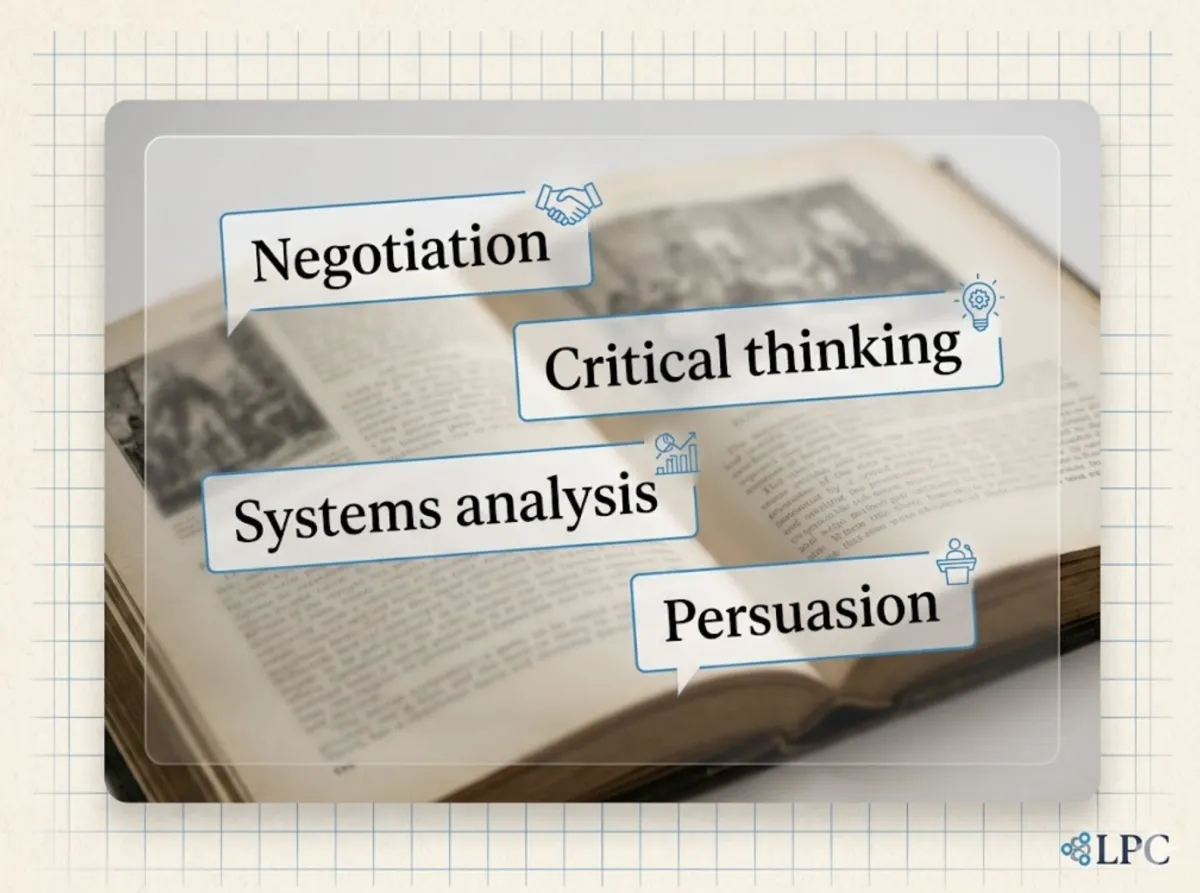
But here’s what’s actually buried in that chapter they’re zoning out on: negotiation strategy. Systems analysis. Persuasion tactics. Critical evaluation of sources. Decision-making under pressure with incomplete information. The life skills parents lose sleep over — the ones that determine whether your teen can navigate conflict, think critically, and advocate for themselves — are already written into their history curriculum. They’re hiding in plain sight.
History Standards Are Life Skills Standards (With Better Costumes)
When your teen’s history standard asks them to “analyze cause and effect across multiple events,” it sounds academic. But translate that into life and it’s: “If I do this, what happens next? And what does that lead to?” That’s systems thinking — the same executive function skill that helps a teen plan backward from a deadline, anticipate consequences before acting, or understand why one argument with a friend cascaded into a whole group fallout.
When the standard asks them to “evaluate the credibility and relevance of multiple sources,” it’s the same skill as deciding whether to trust a product review, a news headline, or a friend’s secondhand account of what happened at a party. Source evaluation isn’t a history skill. It’s a survival skill.
And when they’re asked to “construct arguments using evidence from historical texts”? That’s the blueprint for every job interview answer, every difficult conversation with a roommate, every time they need to make a case for something they want. Claim, evidence, reasoning — it works on a history essay and it works on “Here’s why I deserve a raise.”
Five Skills Your Teen Is Already Practicing (Without Realizing It)
1. Decision-making with incomplete information. Every historical figure they study made choices without knowing the outcome. So does your teen, every day. When they study how leaders weighed options with limited intelligence, they’re building the same muscle they’ll need to choose a college, take a job, or decide whether to confront someone.
2. Perspective-taking. History requires understanding why people with completely different values, pressures, and information made the choices they did. That’s empathy with structure. When your teen can explain why a historical figure acted a certain way without agreeing with them, they’re developing the same skill that helps them navigate disagreements without burning bridges.
3. Pattern recognition across systems. History repeats itself, and the standards know it. When teens identify patterns — how economic stress leads to political change, how innovation disrupts existing industries, how power concentrates and redistributes — they’re learning to see patterns in their own world. The teen who can spot the pattern in history is the same teen who starts noticing patterns in their own spending, relationships, and habits.
4. Persuasion and rhetoric. Every speech, every political movement, every revolution they study is a case study in persuasion. What worked? What didn’t? Why did some arguments change minds while others started wars? This isn’t abstract — it’s the same analysis they need when an influencer is selling them something, when a friend is pressuring them, or when they need to convince you they’re ready for more independence.
5. Understanding that systems shape individual outcomes. This one is the big unlock. History shows teens that individual choices happen inside systems — economic systems, political systems, social systems. When they understand that a factory worker in 1850 had different options than a factory worker in 2026 because of the systems around them, they start asking: what systems am I inside? What are they designed to do? And can I work within them or push to change them?
The Translation Your Teen Needs
The problem isn’t that these skills aren’t in the curriculum. It’s that nobody translates them. Your teen hears “analyze primary sources” and thinks “old documents.” They don’t hear “figure out whether what someone’s telling you is actually true.”
That translation — academic language to life language — is what the Standards to Life™ Framework is built on. It’s not adding a life skills layer on top of academics. It’s showing teens that the academic skill and the life skill are the same skill, wearing different clothes.
Try this with your teen: pick one chapter from whatever they’re studying in history right now. Read the section headings together. Then ask: “What decision is someone making in this chapter? What did they know? What didn’t they know? What would you have done?”
You haven’t added anything to their workload. You’ve reframed what was already there. And suddenly, “why do I need to know this” has an answer that makes sense to them.
What’s Coming This Month
This month, we’re going deep on one specific history topic — the Industrial Revolution — and pulling out everything it teaches about money, work, systems, and decisions that still apply today. If your teen thinks history is irrelevant, this series is going to change that. We’ll connect factory floors to gig economy platforms, child labor laws to employee rights, and technological disruption then to technological disruption now.
Because the best life skills curriculum isn’t a separate class. It’s the one your teen’s already taking — taught in a way that finally makes the connection visible.
Try This Before the Next Blog Post Drops
Open your teen’s history textbook (or whatever they’re working on this week). Find one decision a person or group had to make. Ask your teen: “What would you have done with the information they had?” No grades. No right answer. Just a conversation that lets them practice the skill the standard actually measures — and the skill that’ll matter long after the test is over.
Coming next week: We take the Industrial Revolution and show you exactly how it connects to the money, work, and career questions your teen is already asking. The Industrial Revolution Unit Pack is built on this exact approach — stay tuned.
STANDARDS ALIGNMENT
C3 Framework D2.His.1.6-8 — Analyze connections among events and developments in broader historical contexts
C3 Framework D2.His.16.6-8 — Organize applicable evidence into a coherent argument about the past
CCSS.ELA-LITERACY.RH.6-8.1 — Cite specific textual evidence to support analysis of primary and secondary sources
CCSS.ELA-LITERACY.RH.6-8.8 — Distinguish among fact, opinion, and reasoned judgment in a text
CASEL — Social Awareness: Understanding and empathizing with others from diverse backgrounds and cultures
CASEL — Responsible Decision-Making: Making ethical, constructive choices about personal and social behavior
