Why Life Skills Don't Stick: The Learning Science Behind What Actually Works
You taught them how to do laundry. They nodded. They seemed to get it.
Three weeks later, you find a load of wet clothes sitting in the washer for two days. They look at you blankly. "I forgot."
This isn't defiance. It's not a failure to care. It's not even really forgetting.
It's what happens when life skills are taught in ways that don't account for how learning actually works — especially for the brains most likely to struggle with these skills in the first place. And the learning science that explains why? It's been in education research for decades. We just haven't been applying it at home.
I've spent years thinking about this problem. As a former teacher, as someone who works in workforce development, as a parent navigating this in my own home. And I've come to believe that the way we typically teach life skills is almost designed to fail — not because parents are doing it wrong, but because the container doesn't match the science.
The Standard Approach (And Why It Fails)
Most life skills instruction follows a predictable pattern: adult explains, teen watches, teen does it once supervised, adult assumes skill is acquired, teen is expected to perform independently.
This works for some skills and some learners. For everyone else, it falls apart. And the learning science explains exactly where.
Knowledge isn't competence. In education, Bloom's Taxonomy maps cognitive complexity from simple recall at the bottom to creation and evaluation at the top. Most life skills instruction lives at the bottom two levels — your teen can remember and understand how to do laundry. But the skill you actually need them to have lives at the application level — doing it independently, in a new context, without prompting. That's a completely different cognitive demand, and one demonstration doesn't bridge the gap.
Learning is context-dependent. When your teen learns to do laundry in the laundry room with you standing there on a Saturday afternoon, that's the context their brain encoded. In cognitive psychology, this is called context-dependent memory — the skill gets filed under "that thing I did with Mom that one time," not "how I do laundry." Change the day, remove you from the room, add fatigue or distraction, and the retrieval pathway breaks. The skill didn't vanish. It's locked to conditions that no longer match.
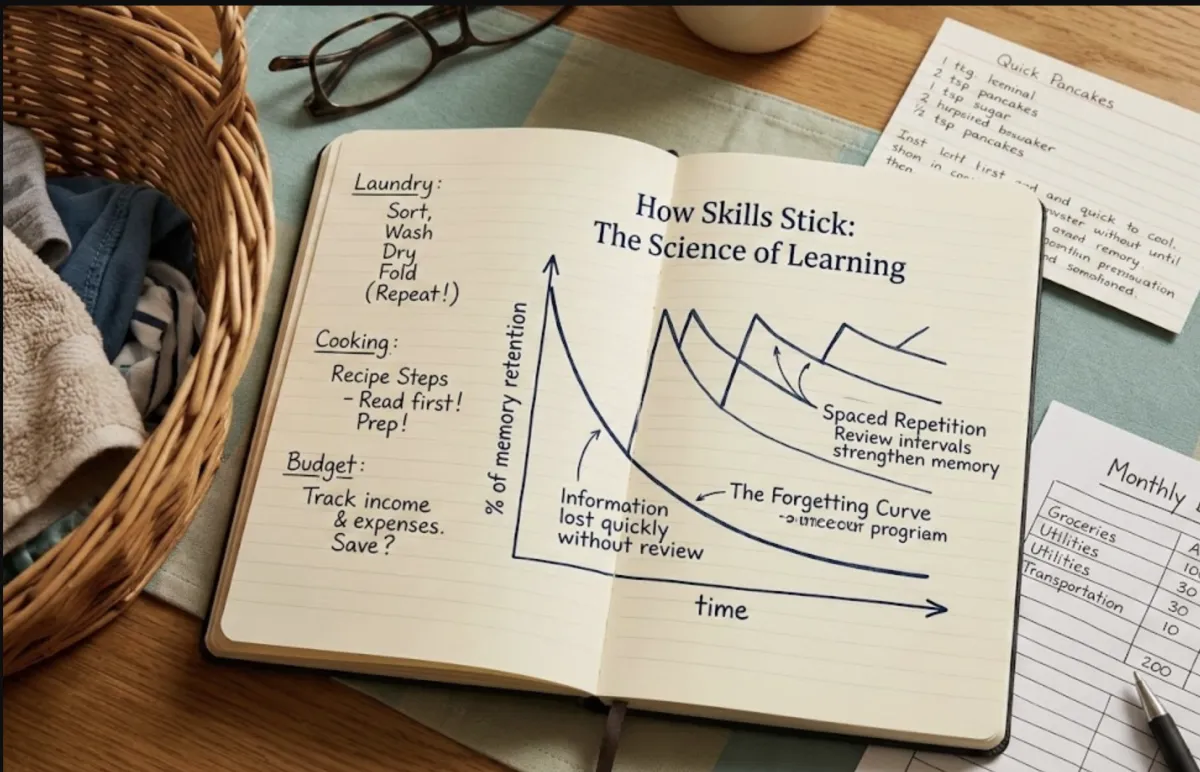
One exposure doesn't create lasting memory. The Ebbinghaus forgetting curve — one of the most replicated findings in psychology — shows that we lose roughly 70% of new information within 24 hours without reinforcement. One demonstration, one practice session, even a few supervised attempts — the science says it's not enough. And yet that's how we usually teach. Show them once, maybe twice, then express frustration when they don't remember.
Compliance isn't competence. "Put the soap here. Set it to this setting. Press start." They follow your instructions. They complete the task. But they were following directions, not building a skill. In learning science, this is the difference between guided performance and independent mastery. The next time, without step-by-step guidance, they're lost — not because they weren't paying attention, but because the cognitive work of decision-making was yours, not theirs.
The Brains That Struggle Most
The teens who most need life skills instruction are often the ones for whom standard instruction works least.
Neurodivergent learners — ADHD, autism, learning differences — often process information differently. They may need more repetition, more explicit instruction, more varied contexts, more support for working memory. Standard "show once, expect forever" instruction fails them first and hardest.
Teens with executive function challenges might understand the skill but be unable to deploy it without scaffolding. The problem isn't knowledge — it's the initiation, sequencing, and working memory demands that execution requires.
Anxious learners encode less during instruction because their cognitive resources are managing the anxiety, not processing the skill. And teens who've internalized that they're "bad at learning" carry that weight into every new instruction — the assumption that they'll fail becomes its own barrier.
None of these are character flaws. They're learning profiles. And effective instruction accounts for them.
→ Interest-Based Nervous System: Teaching When Traditional Methods Fail
→ Why Your Teen's "Laziness" Might Be Task Paralysis
What Actually Makes Skills Stick
Effective life skills instruction looks different from the standard approach because it's built on how learning actually works — the same research that drives good classroom teaching, applied to the kitchen table.
Engagement before instruction. You can't teach someone who isn't engaged. And you can't force engagement — you can only create conditions for it. Before any instruction, answer the question they're definitely thinking: "Why does this matter to me, right now?" Not "you'll need this someday." Why does it matter in their current life, in terms they care about? Maybe they'll do their own laundry because they want their favorite shirt available when they want it. Maybe they'll budget because they want to save for something specific. Find the hook — and know that without it, nothing sticks.
Make the implicit explicit. Most adults have life skills that feel automatic. That automaticity is built on layers of implicit knowledge — things we know but don't consciously think about. In learning science, this is called cognitive apprenticeship: making your expert thinking visible. Narrate your process out loud. Not just what you're doing, but why. "I'm starting the water before I get the pasta out because it takes a while to boil. I'm checking if we have enough sauce before I commit. I'm setting a timer because I always forget." That interior narration is what they're missing — and it's what transforms watching into learning.
Vary the context. If you want a skill to transfer, it needs to be practiced in varied conditions. This is transfer theory — the more contexts a skill is practiced in, the more the brain builds a generalized schema rather than a context-specific memory. Do laundry at home, at the laundromat, at grandma's house. Cook in your kitchen, in a different kitchen, with different equipment. Each variation strengthens the general skill.
Space the repetition. The antidote to the forgetting curve is spaced practice — revisiting a skill at increasing intervals over time. Practice today, again in three days, again next week, again next month. This is how memory consolidates into lasting competence. It's why life skills can't be taught in a one-week unit and then abandoned. They need revisiting.
Scaffold, then fade. In educational psychology, Vygotsky's Zone of Proximal Development describes the space between what a learner can do alone and what they can do with support. Effective instruction lives in that zone — and gradually shrinks it. First time, you're side by side. Next time, they're leading while you're nearby. Next time, you check in at the beginning and end. Eventually, full independence. The fade matters. Support that never reduces creates dependence. Support removed too fast creates failure.
Let mistakes be data. If your teen can't make mistakes without significant consequences or shame, they'll avoid the skill entirely. Create space for low-stakes failure. Let the laundry turn pink. Let the budget fall apart in a simulation. Let the eggs burn when it doesn't matter much. Mistakes with manageable consequences teach better than correct performance under pressure.
→ When Motivation Disappears: Mid-Year Executive Function Reset
Why I Built Curriculum Differently
Most life skills curricula fail because they're designed for compliance, not competence. They present information. They check for understanding. They move on. They don't create engagement, account for different learning profiles, provide sufficient repetition, support transfer across contexts, or fade scaffolding appropriately.
The assumption is that presenting information equals teaching. It doesn't.
This is why the Standards to Life™ Framework exists. I got tired of watching teens "learn" life skills and then not have them. The framework is built on the same learning science we just walked through — engagement before instruction, skills broken to their smallest components, practice in varied contexts, spaced repetition built into the structure, different brains getting different approaches. It's more work than a worksheet. It takes more time than a lecture. And it actually produces teens who can do the things, not just teens who've been told about the things.
For Parents: Applying the Science at Home
You don't need formal curriculum to use these principles. You can shift how you teach life skills starting today.
Stop expecting one-time instruction to stick. If you've shown them once and they didn't remember, that's the forgetting curve doing exactly what the research predicts. Plan for repetition from the beginning.
Narrate your thinking out loud. This is cognitive apprenticeship at home. Not just what you're doing, but the decisions you're making, the cues you're reading, the things you check. Make your invisible expertise visible.
Vary the conditions. If they can only do it at home on Saturday with you watching, they can't do it — they can do it in that specific situation. Intentionally introduce variation so the skill generalizes.
Fade your support systematically. Track where they are. Still need step-by-step guidance? Ready for check-ins at key decision points? Ready for full independence with a debrief after? Match your support to their current level, then reduce it one step at a time.
Let them fail while the stakes are low. Real life includes messing up. Let them practice messing up while you're still available to help them recover. That's not permissive parenting — it's learning science.
The Patience Problem
Teaching life skills well takes longer than teaching them poorly. If you want engagement, you have to take time to create it. If you want transfer, you have to practice in multiple contexts. If you want lasting skill, you have to space repetition over months. If you want independence, you have to fade support gradually.
None of this is fast. And when you're a tired parent who just needs the laundry done, the shortcut is understandable.
But the shortcut produces teens who technically "know" life skills and can't execute them. It produces conflict over the same tasks again and again. The investment in teaching well pays off — it just pays off over time, not immediately.
The Bottom Line
Life skills don't stick because we teach them in ways that don't match how learning actually works.
The science is clear: we lose most of what we learn in 24 hours without reinforcement. Skills encoded in one context don't automatically transfer. Knowing how isn't the same as doing. And compliance under guidance doesn't build independence.
The fix isn't harder lectures or more consequences. It's engagement first, explicit instruction, varied contexts, spaced repetition, gradual fading, and room to fail. It's slower. It's more work. And it actually produces humans who can take care of themselves.
Your teen isn't the problem. The container is the problem. And now you have the science to build a better one.
Related Posts:
Interest-Based Nervous System: Teaching When Traditional Methods Fail
When Motivation Disappears: Mid-Year Executive Function Reset
Executive Function Skills Bundle — "Want the scaffolded system? The Executive Function Bundle builds these skills step by step with spaced repetition built in."
Real-World Lesson Plan Template + Readiness Roadmap (Free) — "Start here: a free template that applies these principles to any life skill you're teaching."
Life Skills Progress Tracker (Free) — "Track where they actually are — not where you think they are."
STANDARDS ALIGNMENT
AP Psychology Unit 5 Cognitive psychology — memory encoding, retrieval, forgetting curve AP Psychology Unit 6 Learning — transfer, reinforcement, scaffolding Education Theory Bloom's Taxonomy Knowledge vs. application vs. synthesis (cognitive complexity levels) Education Theory Vygotsky's ZPD Zone of Proximal Development, scaffolding, gradual release Education Theory Transfer Theory Context-dependent learning, varied practice, generalization NHES Standard 7.12.1–7.12.2 Analyzing and improving personal health practices CASEL Self-Management Goal-setting, self-discipline, organizational skills CASEL Responsible Decision-Making Reflecting on outcomes, evaluating consequences ASCA B-LS 1 Critical thinking skills applied to academic and life success ASCA B-LS 3 Self-management for independence and productivity ASCA B-LS 7 Long-term planning and goal setting
Life Prep Curriculum | Standards to Life™ Framework
