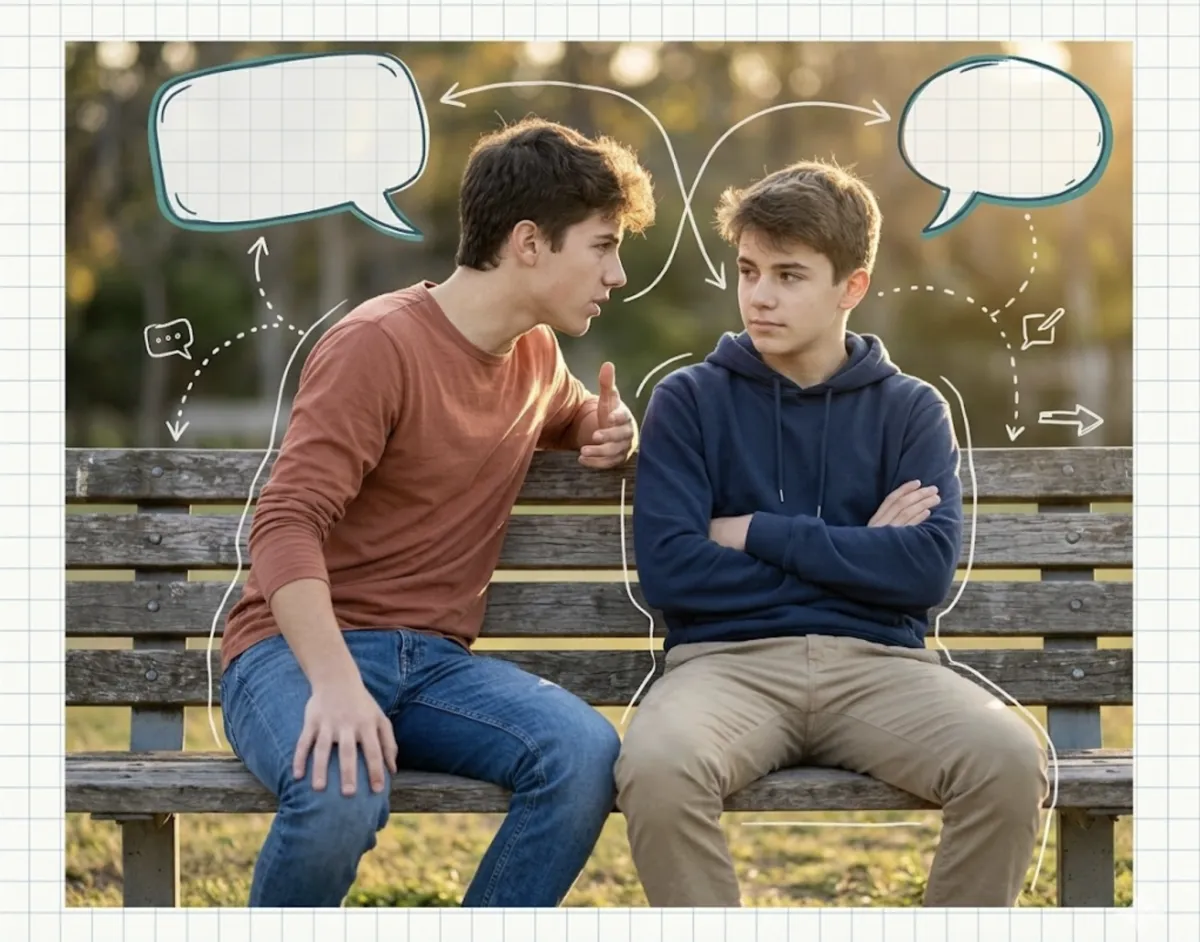
5 Things Your Teen Needs to Know About People Before Leaving Home
Your teen can solve for X. They can write a five-paragraph essay. They can identify mitochondria in a cell diagram and label the parts of the water cycle.
And in eighteen months, they're going to have a roommate who eats their food, a boss who communicates entirely through passive-aggressive emails, and a friend who needs something they don't have the bandwidth to give.
None of the test prep covers this.
The gap between academic readiness and people readiness is enormous — and it's the gap that actually determines whether your teen thrives or just survives in the years after they leave your house. Not because academics don't matter. They do. But because every job, every living situation, every meaningful relationship requires skills that show up in no curriculum and on no transcript.
Your teen needs to understand five things about people before they walk out that door. Not five theories. Not five inspirational posters. Five functional skills they'll use every single day.
I've been writing about each of these in depth over the past few months. This post connects them into a reading path — the order that builds one skill on top of the next, the way they'd actually unfold in real life.
1. What Healthy Actually Looks Like
Here's the problem with how we teach teens about relationships: we start with what to avoid.
Red flags. Warning signs. Toxic behaviors. Don't date someone who does this, watch out for people who say that.
It's the equivalent of teaching someone to drive by only showing them car crash footage. They'll know what a wreck looks like. They won't know how to steer.
Your teen needs a working model of what healthy relationships feel like — not just romantic ones, but friendships, work relationships, family dynamics. What does mutual respect look like in practice? What's the difference between healthy interdependence and codependence? What does it mean to repair after conflict instead of pretending it didn't happen?
→ Healthy Relationships 101: What Teens Actually Need to Know builds that model from the ground up. It covers the four relationship foundations (mutual respect, communication patterns that work, healthy interdependence, and repair), addresses the digital-age complications your teen is navigating right now, and gives parents conversation starters that don't feel like interrogations.
This is the foundation piece. Everything else in this list assumes your teen has some understanding of what they're building toward.
2. How to Protect Their Peace Without Burning Bridges
One of the most persistent false choices teens face: be a doormat or be "difficult."
They absorb everyone else's needs because that's what keeps the peace. They say yes to plans they don't want, tolerate behavior that bothers them, give up things that matter — because the alternative feels like losing the relationship entirely.
This is the boundary gap. Not knowing that boundaries exist, but knowing how to actually set one in real life — with friends, with family, online — without detonating the connection.
→ Setting Boundaries Without Burning Bridges is the most practical post in this cluster. It includes actual scripts — the exact words a teen can use when they need space, when someone pushes past a limit, when a family member shares something that wasn't theirs to share. It also covers what happens when boundaries get pushback, and what healthy versus concerning responses to a boundary look like.
The academic parallel runs through the entire piece. The same persuasive communication framework your teen's English class requires — claim, evidence, reasoning — is the structure behind every effective boundary statement. "I need this [claim] because this is what happens when it's crossed [evidence], and here's what I'm asking for [reasoning]." They already have the academic tool. This post connects it to the life application.
3. How to Handle Disagreement Without Disappearing
Some teens run toward conflict. They argue, they push back, they defend their position at full volume.
This post isn't for them.
This is for the teen who would rather fail silently than risk a disagreement. The one who says "I don't care" when they absolutely do. The one who absorbs everyone else's preferences because having their own feels too dangerous.
Conflict avoidance looks like agreeableness from the outside. From the inside, it's exhausting. And it creates a pattern that follows them into every future relationship — the roommate whose mess they never mention, the coworker whose work they silently pick up, the partner whose needs always come first.
→ Conflict Resolution for Teens Who Avoid Conflict reframes conflict as a skill, not a personality trait. It starts with why some teens avoid — anxiety, people-pleasing, demand avoidance, past experiences where disagreement led to consequences — and works toward practical strategies for engaging in low-stakes disagreements first.
The key reframe: conflict isn't the opposite of a good relationship. Avoidance is. Every healthy relationship involves friction. The skill is navigating the friction, not preventing it.
For neurodivergent teens, especially those with a PDA profile, this connects directly to the demand avoidance work — because interpersonal expectations can register as demands, and the avoidance response kicks in before the teen even knows what happened.
4. How to Repair What's Broken
Here's the thing about the first three skills: even when your teen has them, they'll still mess up. They'll cross someone's boundary. They'll say the wrong thing in an argument. They'll be the one who wasn't listening when they needed to be.
And in that moment, the skill that matters most is the one almost nobody teaches: how to apologize.
Not "I'm sorry you feel that way." Not "sorry, but..." Not the non-apology that protects the apologizer while dismissing the person who was hurt.
An actual repair. One that acknowledges what happened, takes responsibility for their part, and demonstrates a change — not just a sentence.
→ How to Apologize (When You're the One Who Messed Up) covers the anatomy of a real apology, why most teen apologies fail (and it's not because they don't feel remorse), and scripts for repair in different contexts — friendships, family, digital communication, and the moments when you don't feel like you did anything wrong but the other person is hurt anyway.
This is the post that completes the relationship cycle. You build healthy connections (Post 1), protect them with boundaries (Post 2), navigate the inevitable friction (Post 3), and repair when things go sideways (this one). Without repair skills, every conflict becomes a potential ending instead of a turning point.
5. How to Ask for What They Need
There's a thread that runs through all four skills above, and it's this: every one of them requires the ability to identify what you need and communicate it clearly.
Setting a boundary requires knowing where your limit is. Navigating conflict requires articulating your perspective. Repairing a relationship requires explaining what went wrong and what needs to change. Even recognizing a healthy relationship requires enough self-awareness to know what "healthy" means for you.
Self-advocacy is the underlying skill. Without it, your teen has theoretical knowledge about relationships but no mechanism for applying it in the moment.
→ The Skill No One Teaches: How to Help Your Teen Ask for What They Need breaks self-advocacy into layers: first self-awareness (knowing what you need), then language (having the words), then delivery (choosing the moment and method), then persistence (following up when the first attempt doesn't land).
This post connects to the academic framework most directly. Self-advocacy is structured argument — the same claim + evidence + reasoning framework that appears in every ELA classroom in America. When your teen says "I need extended time on this assignment because I process information differently, and here's what I'm asking for," they're writing a persuasive essay in real time. They already have the academic skill. Self-advocacy is the life version.
Why This Order Matters
These five aren't random. They build.
You can't set a boundary if you don't know what a healthy relationship looks like (Post 1 → Post 2). You can't navigate conflict if you don't have boundaries to hold (Post 2 → Post 3). You can't repair if you can't tolerate the discomfort of acknowledging harm (Post 3 → Post 4). And none of it works without the self-awareness and communication skills of self-advocacy running underneath everything (Post 5).
This is also why your teen can't learn them all from a weekend workshop or a health class unit that covers "communication skills" in three days. These are iterative. They get practiced in low-stakes moments — the friend who cancels plans, the sibling who borrows without asking, the group project where one person does nothing — and they develop over time.
The Standards to Life™ Framework is built on this understanding: life skills aren't add-ons to academics. They are the academic skills, applied to the arena that actually matters. Persuasive writing is boundary-setting. Collaborative discussion is conflict navigation. Textual analysis is reading social dynamics.
Your teen is already learning the building blocks in every class they take. The missing piece is the explicit connection between "here's the skill that gets you an A" and "here's the skill that gets you through a hard conversation."
Before they leave your house, they need both.
Your Reading Path (Save This)
Build in order:
If you need tools now:
Real-World Communication Skills Bundle — Practical communication frameworks teens actually use
Self-Advocacy Communication Mini-Lesson — Scripts and practice for finding the words
Life Skills Progress Tracker (Free) — See where the people skills gaps are
Related Posts:
Your Teen Isn't Lazy, Broken, or Defiant: A Parent's Guide to What's Actually Going On
Why "Just Do It" Backfires: Teaching Life Skills to Demand-Avoidant Teens
Spring Break Is a Life Skills Final Exam (And Your Teen Doesn't Know They're Taking It)
STANDARDS ALIGNMENT
CCSS ELA: SL.9-10.1 (collaborative discussion), W.9-10.1 (argument writing — self-advocacy as structured argument), RI.9-10.6 (point of view and rhetoric — reading social dynamics), SL.8.1 (collaborative discussion with diverse partners)
CASEL: Self-awareness, self-management, social awareness, relationship skills, responsible decision-making (all five core competencies)
ASCA Mindsets & Behaviors: B-SS 2 (positive relationships), B-SS 3 (positive relationships with adults), B-SS 8 (advocacy skills for self and others), B-SMS 2 (self-discipline and self-control)
NHES: Standard 4 (interpersonal communication), Standard 8 (advocacy for personal, family, and community health)
CCSS ELA Writing (implicit): W.9-10.1a-e (argument writing — the structural framework behind every boundary, apology, and advocacy moment)
Life Prep Curriculum | Standards to Life™ Framework
